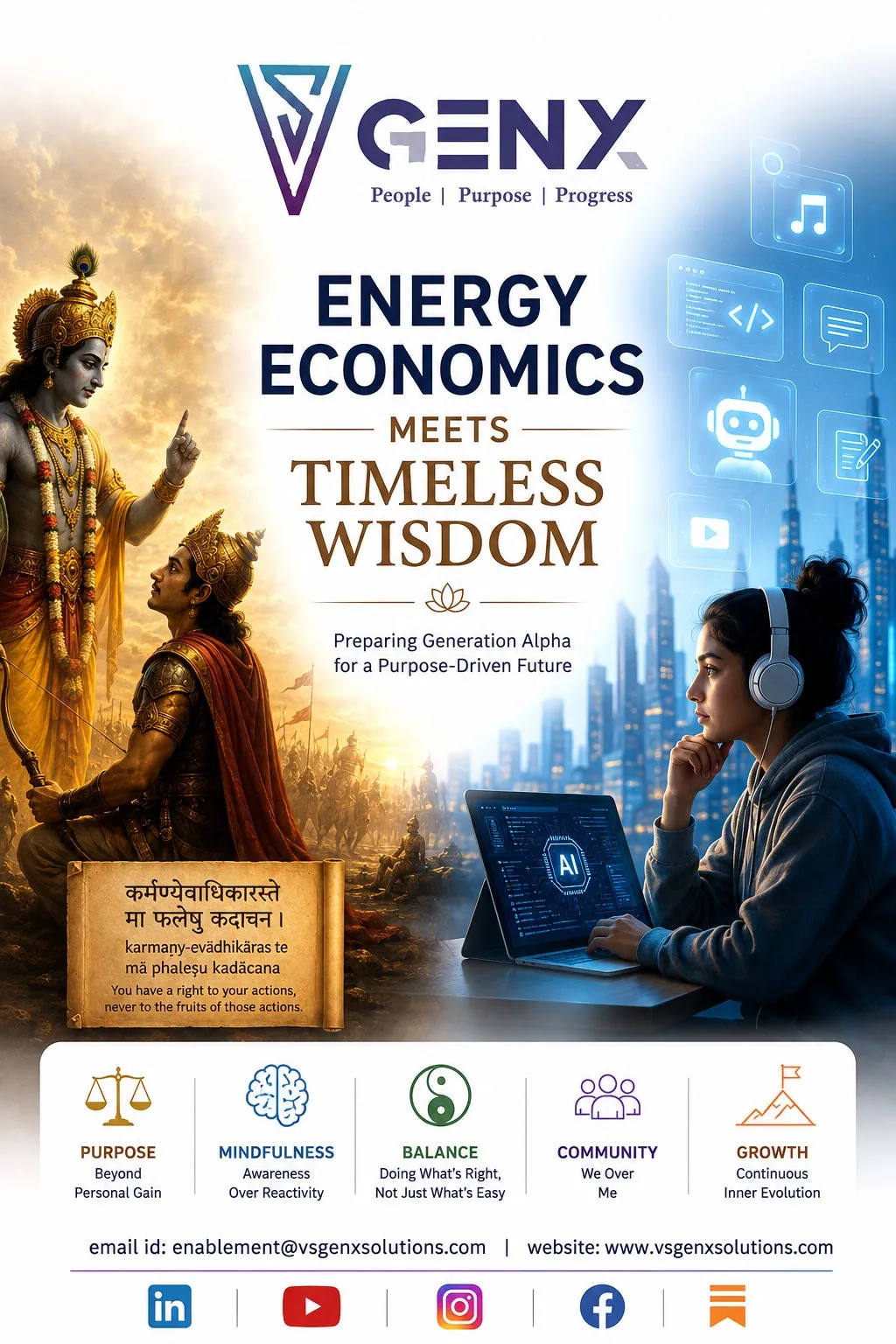
There is a moment in the Bhagavad Gita where a warrior named Arjuna puts down his bow in the middle of a battlefield and refuses to fight. Not because he is weak. Because he cannot see the point. His teacher’s answer, karmaṇy-evādhikāras te mā phaleṣhu kadāchana, meaning “you have a right to your actions, never to the fruits of those actions,” has been recited in classrooms, ashrams and now, increasingly, in leadership offsites for twenty-five centuries.
Now picture a fourteen-year-old today, growing up narrating her own life for a phone camera, asking a chatbot to explain her homework, watching Artificial Intelligence compose music, code, and essays in seconds. When she enters the workforce in the early-to-mid 2030s, will she put down the bow too? Not from weakness, but from a sharpened, almost mathematical sense that effort should be justified before it is spent.
That is precisely the question a recent People Matters Big Questions panel, featuring Bhavya Misra (Chief Human Resources Officer, Godrej Capital), Professor Snehal Shah (SPJIMR), and Nimisha Dua (Chief People Officer, Space Matrix), put in front of Indian business leaders.
Nimisha Dua’s framing was the sharpest line in the discussion: she called it “energy economics,” a coming generation of workers who will ask, before doing almost anything, whether a piece of work is worth the energy it costs them.
That single phrase is worth sitting with. It sounds like a very 2026 idea: Generation Z burnout culture, quiet quitting, TikTok career philosophy. But it is also, almost word for word, the inverse of what Krishna told Arjuna on that battlefield. And that collision, modern “energy economics” versus ancient “renounce the fruits,” is where this piece lives. Because the tension between them is not a coincidence. It is the same question, asked by every generation that has had enough security to stop and ask it, and answered differently depending on what tools, information and options that generation had at hand.
This is an attempt to take that panel discussion seriously, not as a Human Resources trend piece, but as a genuine inquiry, using organizational science, cognitive psychology, and Eastern philosophical traditions (Vedantic, Taoist, Buddhist and Confucian) as three independent lenses on the same phenomenon. If they converge, that convergence is worth your attention. If they diverge, the disagreement is even more interesting.
1. The data behind the discomfort
Before philosophy, the numbers, because leaders will not restructure organizations on the strength of a panel discussion alone, and they should not have to.
Engagement is already collapsing, for the workers you have now. Gallup’s State of the Global Workplace reporting shows global employee engagement fell to just 20% in 2025, its lowest level since 2020, with managers, not entry-level staff, showing the sharpest declines in their own engagement and wellbeing. This is not a “kids these days” problem. It is a systemic one, and it predates Generation Alpha by a full generation.
The generation currently in the workforce is already renegotiating the deal. Deloitte’s 2026 Global Generation Z and Millennial Survey (22,595 respondents, 44 countries) found that only 25% of Generation Z and 21% of millennials want rapid promotion; 44% and 45% respectively prefer steady, deliberate advancement, and roughly one in five would willingly take a lateral move or even a step back for better long-term fit. Only 6% cite “becoming a leader” as their primary career goal, even though a large majority (76% of Generation Z, 67% of millennials) say they would want senior leadership eventually. The barrier is not ambition, it is burnout and work-life cost, cited by roughly half of respondents.
Artificial Intelligence is not a future disruption; it is already the daily operating environment. The same survey found Artificial Intelligence daily usage jump to 74% in a single year, up from roughly 56 to 57% the year before, with 79% of respondents using it for learning, and 58% of Generation Z reporting digital fatigue from that same environment.
The World Economic Forum’s Future of Jobs Report 2025 estimates that by 2030, 170 million jobs will be created and 92 million displaced (a net gain of 78 million), that nearly 40% of the core skills required in most jobs will change, and that 59 out of every 100 workers will need meaningful reskilling, with a meaningful fraction of them unlikely to receive it, putting over 120 million workers at risk. 63% of employers already name the skills gap as their single biggest barrier to transformation.
Put together: the workforce entering their first jobs right now is already asking Dua’s question. Generation Alpha (the cohort born roughly 2010 to 2024, raised entirely inside algorithmic feed culture and now growing up alongside generative Artificial Intelligence as a native tool rather than a novelty) will likely ask it more explicitly, more instrumentally, and earlier in their careers, because they will have grown up watching institutions (schools, media, even parents) get outpaced by tools faster than those institutions could adapt.
2. The scientific case for “energy economics”
Dua’s phrase is not a slogan; it maps cleanly onto sixty years of motivation research.
Self-Determination Theory, developed by psychologists Edward Deci and Richard Ryan, is one of the most replicated frameworks in organizational psychology. It holds that sustained human motivation depends on three needs being met: autonomy (control over one’s own actions), competence (a sense of mastery and growth), and relatedness (meaningful connection to others). A large body of applied research, summarized in Deci, Olafsen and Ryan’s “Self-Determination Theory in Work Organizations: The State of a Science” (2017), shows that when these needs go unmet, engagement does not decline gently, it collapses, regardless of pay. This is the scientific skeleton underneath “is this work worth my energy”: the brain is not asking about salary, it is auditing whether the activity feeds autonomy, competence and relatedness, or drains them.
Job crafting research, pioneered by Amy Wrzesniewski and Jane Dutton (“Crafting a Job: Revisioning Employees as Active Crafters of Their Work,” Academy of Management Review, 2001), found that employees in even the most rigid, low-status jobs actively reshape the boundaries, relationships and meaning of their work to make it bearable and worthwhile. Generation Alpha will not invent this instinct, they will simply have more tools (Artificial Intelligence copilots, gig platforms, portfolio careers) to act on it faster and with less institutional patience than any generation before them.
Flow theory, from Mihaly Csikszentmihalyi, and subsequent work applying it through a Self-Determination Theory lens (“Flow at Work: A Self-Determination Perspective,” Occupational Health Science, 2017) shows that people do their best and most sustained work not when incentivized by rewards, but when a task’s challenge is precisely matched to their skill and they have enough autonomy to adjust it. “Energy economics” is, functionally, an early-warning system for flow’s absence: when a worker can immediately sense a mismatch between effort demanded and meaning returned, they disengage before a manager even notices.
And there is a scientific counterweight worth taking seriously: the “digital native” hypothesis is weaker than it sounds. A widely cited critical review by Bennett, Maton and Kervin (“The ‘Digital Natives’ Debate: A Critical Review of the Evidence,” British Journal of Educational Technology, 2008) found the empirical case for a neurologically or cognitively distinct “digital native” generation to be thin. Technology use varies enormously within generations by access, class, and disposition, not just between them. Pew Research Centre itself now explicitly cautions against treating generational cohorts as unified psychological types, noting that what looks like a “generational” trait is frequently a lifecycle effect (something true of all 16-year-olds, in any decade) or a period effect (something an entire society experienced together, regardless of age) rather than a trait fixed at birth by a calendar boundary. A “typical generation,” Pew notes, spans 15 to 18 years, hardly a single psychology.
This matters, and it should sharpen rather than soften the argument: we are not saying Generation Alpha’s brains are different. We are saying their environment is different, and environments shape behavior far more reliably than birth years do. Herbert Simon’s 1971 observation that “a wealth of information creates a poverty of attention” was made decades before smartphones existed, describing a structural fact about any information-saturated system, not a personality trait of any cohort. Generation Alpha is simply the first generation to be born inside that saturated system rather than migrating into it as adults, which is a difference of degree, not of kind, but a very large degree indeed.
3. Three Eastern traditions, three different answers, and where they meet
This is where the panel’s language stops sounding like Human Resources theory and starts sounding like philosophy that has already been argued out, in detail, over thousands of years.
Karma yoga: renounce the fruit, not the effort
The Gita’s teaching in chapter 2, verse 47 is often flattened into “do not care about outcomes.” That is a misreading. Krishna’s actual instruction to Arjuna is more precise: perform your duty (dharma) with full effort, but do not let your motivation be hostage to the result, because results depend on countless factors outside your control. This is not indifference to outcomes, it is a technique for staying engaged despite uncertain outcomes, by relocating the source of meaning from the result to the act itself.
Held up against “energy economics,” this is a genuine philosophical tension worth naming honestly rather than smoothing over: karma yoga asks workers to detach meaning from outcome; energy economics asks workers to attach effort only where outcome (or at least worth) is legible in advance. One is a discipline for enduring uncertainty. The other is a filter for avoiding it. A charitable reading is that they are two ends of the same insight, that unexamined, compulsory effort divorced from any sense of ownership is what burns people out, whether the third-century BCE version of that trap was caste duty and social obligation, or the 2026 version is a Tuesday full of status-update meetings nobody asked for. Both traditions, ancient and emergent, are reacting against the same enemy: effort without agency.
Wu wei: the leader whose team says “we did it ourselves”
The Tao Te Ching, attributed to Laozi, offers a leadership model built almost entirely around restraint. Chapter 17 describes four grades of ruler, the best of which is barely noticed by the people, so that when the work is done, they say, “we did this ourselves.” Chapter 63 develops wu wei, often translated “non-action” but better understood as effortless, unforced action: achieving through alignment rather than force, timing rather than command.
This maps with uncomfortable precision onto what the panel described as the death of command-and-control leadership. Nimisha Dua’s observation, that Generation Alpha may ask whether authority should come from job titles or from expertise and insight, is Taoist leadership theory restated in Human Resources language. Wu wei does not mean a leader does nothing. It means a leader’s authority is earned through demonstrated skill and correctly-timed intervention, not asserted through hierarchy. A command-and-control manager in a wu wei framework is not just old-fashioned, they are, by definition, doing it wrong, because forced authority generates resistance in direct proportion to how hard it pushes.
Confucian merit: virtue cultivated, not inherited
It is tempting to treat “Eastern philosophy” as a single monolithic voice, but Confucianism offers a useful counterweight to pure Taoist non-interference. The Confucian ideal of the junzi, often translated “noble” or “exemplary person”) is explicitly meritocratic in a moral sense: status is earned through cultivated virtue, learning, and ritual propriety, not birthright. Confucius’s entire educational project was premised on the radical-for-its-time idea that moral and intellectual excellence could be taught and earned by anyone willing to do the work, hence his famous acceptance of students “with as little as a bundle of dried meat” as tuition, regardless of birth. This gives useful texture to the panel’s authority-from-expertise theme: Generation Alpha’s likely rejection of title-based authority is not a rejection of hierarchy itself, but a demand that hierarchy be re-earned continuously through demonstrated competence, closer to Confucian meritocracy of virtue than to pure Taoist absence of structure.
Right Livelihood: work as an ethical, not just economic, act
The Buddhist Noble Eightfold Path includes samyak ājīva, Right Livelihood, the principle that one’s occupation itself should not cause harm, and should be aligned with one’s ethical values. It reframes “is this work worth it” not as a purely personal energy calculation, but as a question with a moral dimension: worth to whom, and at what cost to others? This adds a layer the “energy economics” framing risks missing if read too individualistically. Generation Alpha’s expected scrutiny of employers (their climate record, labor practices, social impact, and the honesty of their Artificial Intelligence use) is Right Livelihood applied at organizational scale, and it shows up empirically too: Deloitte’s own data shows Generation Z and millennials weighing an employer’s ethics and environmental record as seriously as pay when evaluating where to work.
Ikigai, and a necessary correction
No article invoking East Asian philosophy of work is complete without ikigai, and it is worth pausing to correct a widely repeated myth about it, because the correction is itself instructive. The now-ubiquitous four-circle Venn diagram, “what you love,” “what you are good at,” “what the world needs,” “what you can be paid for,” is not a traditional Japanese concept. Researchers into the diagram’s history trace it to a 2014 blog adaptation by a Westerner, Marc Winn, of an unrelated Spanish diagram about career purpose, later merged with the Japanese word ikigai and marketed globally as ancient wisdom. The actual, older Japanese concept of ikigai, as described by psychiatrist Mieko Kamiya and more recently by neuroscientist Ken Mogi, is subtler and less transactional: it is often small, communal, and does not require being “paid for” at all, tending a garden, a daily ritual, a relationship. It is a reminder to be applied to this entire article: when ancient wisdom gets flattened into a management diagram, something essential is usually lost. Generation Alpha, raised media-literate and skeptical of curated narratives, may be the first generation to instinctively distrust exactly this kind of repackaged spirituality-as-productivity-hack, which is itself a psychologically interesting prediction, and a warning to any leader tempted to bolt “purpose” onto a role as a retention gimmick rather than build it structurally.
4. From ladders to lattices, and why career science already predicted this
Professor Snehal Shah’s framework, progression from Promotion to Possibilities to Plausibility’s, is not just a clever alliteration. It closely tracks two established streams of career theory: the boundary-less career (Arthur and Rousseau, 1996), which describes careers increasingly built across organizations rather than within one, and the protean career (Hall, 1976; revisited 2004), which argues career success is shifting from externally defined metrics (title, salary, tenure) to internally defined ones (psychological success, identity, values fit).
The “ladder to lattice” metaphor Shah used is a direct descendant of this literature, and it explains something the panel only implied: Generation Alpha will not reject structure entirely. They will reject single-axis structure, the assumption that the only legitimate direction of growth is up. A lattice still has rules, still has effort, still has skill accumulation. It simply refuses to pretend that “up” is the only direction that counts, which is a very Taoist critique of a very Confucian-bureaucratic system, and a reminder that even within “Eastern philosophy,” the traditions argue with each other as much as they argue with the West.
5. The honest caveat, and why it makes the argument stronger, not weaker
A rigorous piece has to say this plainly: nobody knows Generation Alpha yet. The oldest members of this cohort are still teenagers; the panel itself acknowledged this is prediction, not observation. Pew’s own methodological caution applies directly here: a “typical generation” spans 15 to 18 years of birth cohorts with enormous internal diversity, and much of what gets attributed to “generational character” is really a lifecycle effect (every 16-year-old in history has questioned authority) or a period effect (a recession, a pandemic, an Artificial Intelligence wave hitting every age group at once, not just the young).
But here is why that caveat strengthens, rather than undermines, the case for paying attention now: the forces driving this shift (algorithmic attention economies, Artificial Intelligence as ambient infrastructure rather than novel tool, declining global engagement even among current workers, a genuine and growing skills-obsolescence rate) are structural, not generational. They will shape whoever enters the workforce in the 2030s almost regardless of what quirks of temperament that cohort happens to have. You do not need to believe in fixed generational psychology to believe that an organization built entirely around vertical promotion, title-based authority, and long-format training will struggle against a labor market shaped by these forces. The generational label is a convenient shorthand for a set of environmental pressures that are already measurable today, in today’s engagement scores, today’s Artificial Intelligence adoption curves, and today’s skills-obsolescence timelines.
6. The provocation
Put the three traditions and the two research streams side by side and a single, uncomfortable insight emerges: every framework here (Vedantic, Taoist, Buddhist, Confucian, and modern organizational psychology) treats forced, unexamined, meaning-starved effort as the actual enemy, not effort itself. Karma yoga does not ask Arjuna to stop fighting; it asks him to fight without ego-attachment to victory. Wu wei does not ask a leader to abdicate; it asks them to lead so well that force becomes unnecessary. Self-Determination Theory does not say pay does not matter; it says pay without autonomy, competence, and relatedness produces disengagement no salary can fix.
So here is the question worth sitting with, whether you lead five people or five thousand: how many rituals in your organization survive only because “that is how it is done,” and would any of them survive a Generation Alpha audit, a Self-Determination Theory audit, or a karma-yoga audit? The three-hour status meeting nobody enjoys. The promotion track that rewards tenure over contribution. The authority that rests on a title rather than demonstrated insight. The “purpose statement” bolted onto a role that structurally offers none.
Generation Z was the tremor. The panel’s consensus, and the data behind it, suggests Generation Alpha will be closer to the quake. The organizations that survive it will not be the ones that design a clever “Generation Alpha policy.” They will be the ones that already, structurally, pass the oldest test in the world: does this work deserve the energy a human being is being asked to give it?
References
Srivastava, Samriddhi. “The future workforce will be fundamentally different: What leaders expect from Generation Alpha,” People Matters, September 1, 2026.
Dua, Nimisha, profile and context via “Why Chief Human Resources Officers must treat workplace design as a people strategy,” People Matters.
Deloitte. “Deloitte Global 2026 Generation Z and Millennial Survey, press release,” Deloitte Global, 2026.
Deloitte. “Deloitte Global Generation Z and Millennial Survey,” Deloitte Global, 2026.
World Economic Forum. “Future of Jobs Report 2025: 78 Million New Job Opportunities by 2030 but Urgent Upskilling Needed,” January 2025.
World Economic Forum. “The Future of Jobs Report 2025,” full report, January 2025.
Gallup. “State of the Global Workplace,” Gallup, 2025 and 2026 editions.
Pew Research Center. “How Pew Research Center will report on generations moving forward,” May 22, 2023.
Deci, E. L., Olafsen, A. H., and Ryan, R. M. “Self-Determination Theory in Work Organizations: The State of a Science,” Annual Review of Organizational Psychology and Organizational Behavior, 2017.
American Psychological Association. “Self-determination theory: A quarter century of human motivation research,” American Psychological Association.
Wrzesniewski, A., and Dutton, J. E. “Crafting a Job: Revisioning Employees as Active Crafters of Their Work,” Academy of Management Review, 26(2), 2001.
“Flow at Work: A Self-Determination Perspective,” Occupational Health Science, 2017.
Bennett, S., Maton, K., and Kervin, L. “The ‘Digital Natives’ Debate: A Critical Review of the Evidence,” British Journal of Educational Technology, 39(5), 2008.
Bhagavad Gita, Chapter 2, Verse 47, translation and commentary via Swami Mukundananda, Holy Bhagavad Gita.
Lao Tzu, Tao Te Ching, Chapters 17 and 63, translations collected at egreenway.com and harinam.com.
Confucius, Analects; Confucian conception of the junzi and meritocracy of virtue, via Stanford Encyclopedia of Philosophy, “Confucius”.
Ikigai, origin of the popular four-circle diagram versus the traditional Japanese concept (Mieko Kamiya, Ken Mogi), via Ikigai Tribe, “Ikigai Misunderstood and the Origin of the Ikigai Venn Diagram.”
Simon, Herbert A. On information-rich environments producing a “poverty of attention,” 1971, as discussed in Conversable Economist, “Economics of Information Overload: Thoughts from Herb Simon.”
Arthur, M. B., and Rousseau, D. M. (eds.), The Boundaryless Career: A New Employment Principle for a New Organizational Era, 1996, foundational framework for cross-organizational career theory.
Hall, D. T. Careers In and Out of Organizations, the protean career concept, 1976, revisited 2004, foundational framework for internally defined career success.
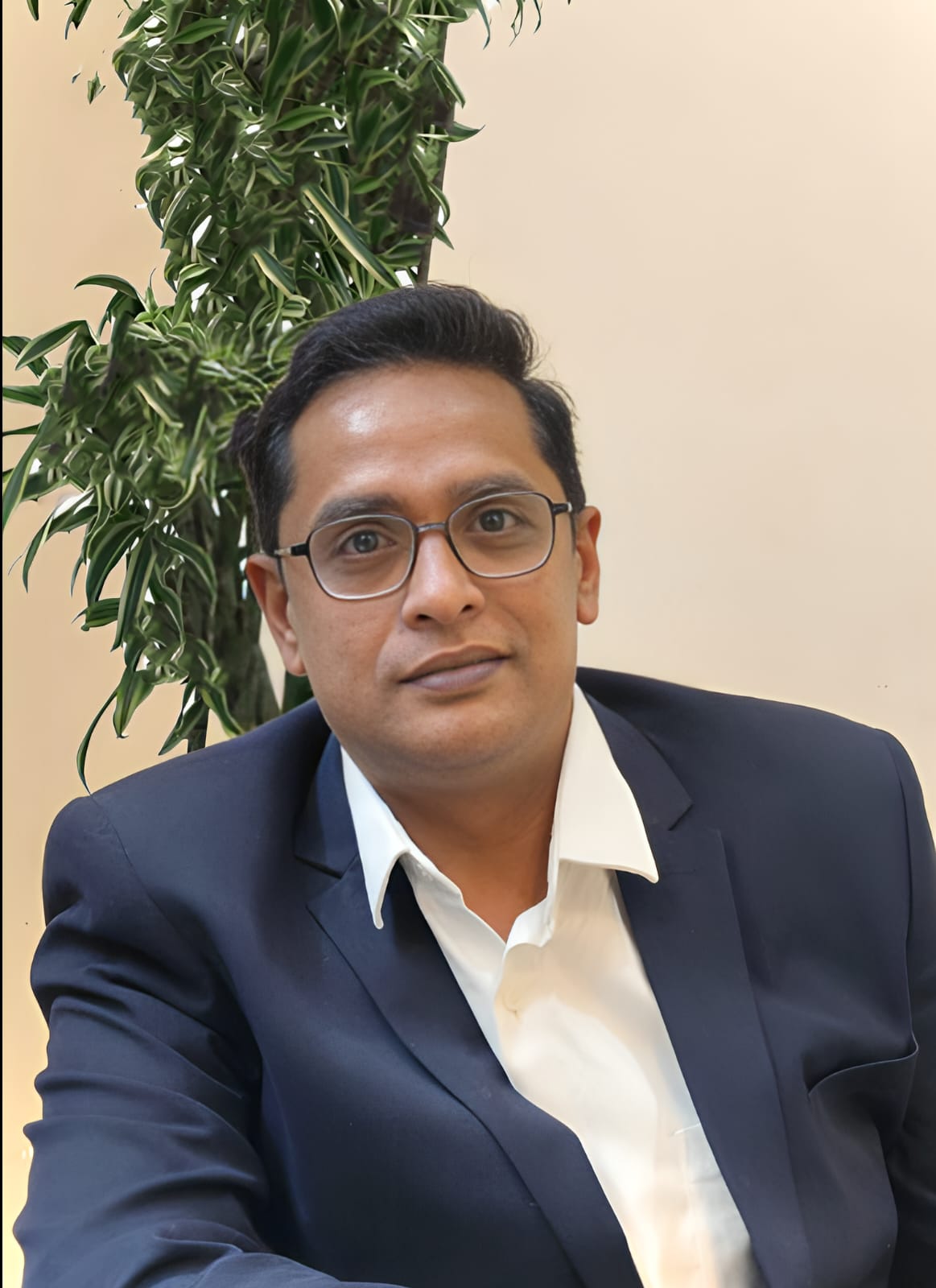
Venkatesan Srinivasan (Venkat)
Founder, VS GenX Solutions
Venkat is an HR transformation practitioner with 20+ years of experience across technology, fintech, telecom, product development and Global Capability Centers, with a particular focus on helping growing organizations build people systems that can scale with their ambitions.
He founded VS GenX Solutions around a simple conviction: HR should not merely support business, but should help shape how people, purpose and progress come together. His work spans HR transformation, leadership development, AI-driven HR automation and building inclusive, future-ready workplaces for startups and SMEs.
His larger purpose extends beyond consulting: to create sustainable growth opportunities for talented individuals from underprivileged communities across India, with VS GenX Solutions committing 5% of its earnings towards this cause.
Connect with Venkat
Email: enablement@vsgenxsolutions.com
Website: www.vsgenxsolutions.com
People | Purpose | Progress
Originally published on Venkat's Substack. Subscribe for free to receive new articles.