A number worth getting precisely right
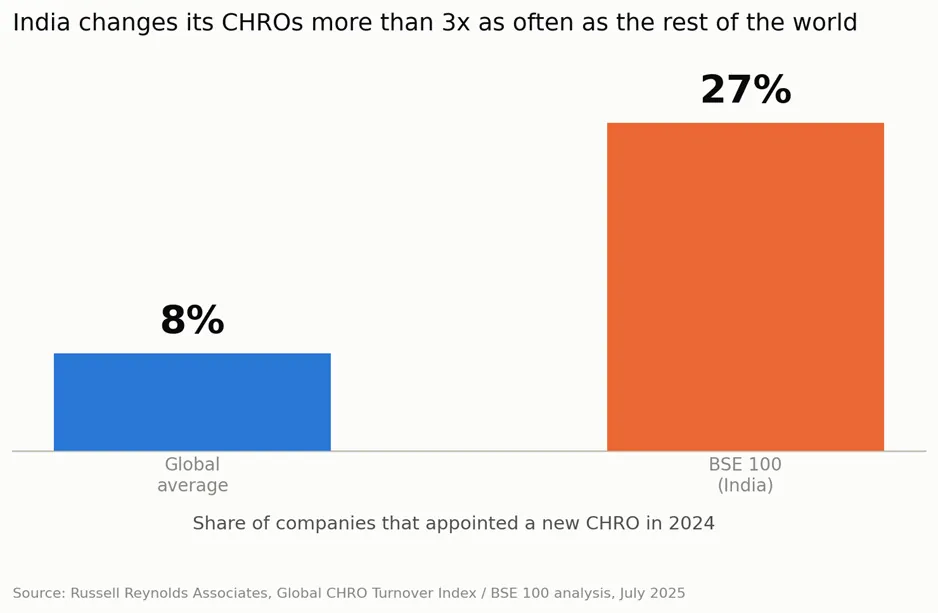
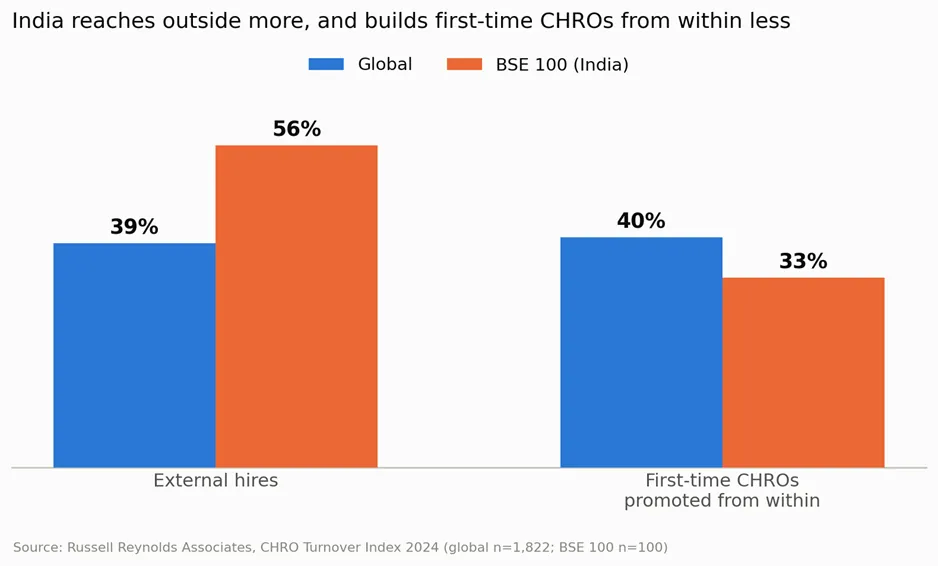
27% of BSE 100 companies appointed a new CHRO in 2024. That is more than three times the global average of 8% reported by Russell Reynolds Associates.
Before going further, one distinction is worth holding onto through the whole article, because it is easy to blur and it changes the meaning of everything that follows.
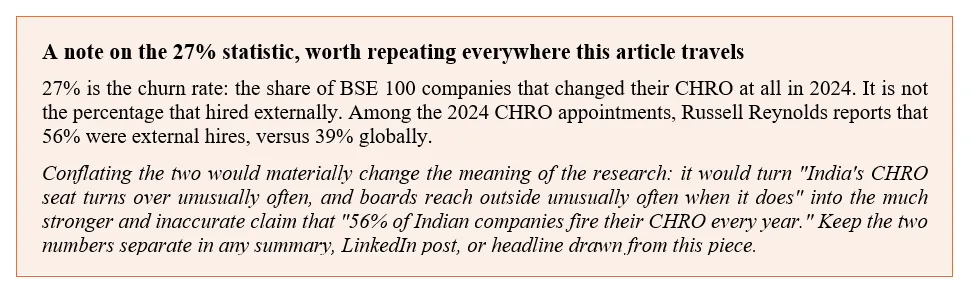
What the research says is narrower, and in some ways more interesting: India’s CHRO seat turns over unusually often, and when it does, boards reach outside unusually often too. Two separate facts, both real, both worth explaining.
The job itself has quietly tripled in scope over the last decade. Russell Reynolds now describes the CHRO mandate in terms of enterprise transformation, organizational design, operating-model change, culture, and the workforce implications of AI. A modern CHRO is expected to influence organizational transformation, culture, leadership architecture, workforce strategy, AI adoption, productivity, M&A integration, succession, employee experience, and business growth, often all at once.
That creates a genuine paradox, and it sits underneath the whole internal-versus-external debate. A board says, in effect, “we want a CHRO who understands our culture deeply.” In the same breath, it says, “we want this person to fundamentally change our culture.” Those two requirements are not naturally aligned. The person best positioned to understand a culture is, almost by definition, someone who has been shaped by it. The person best positioned to challenge it is someone who hasn’t.
The case for building the CHRO internally, and it is a real case
An internal candidate starts with something an external hire has to spend six to twelve months acquiring: they already know how decisions actually get made, who really influences whom, where resistance to change lives, why the last three initiatives quietly died, and what the CEO and board will and won’t tolerate. That is not a small advantage. It is, in a very literal sense, months of runway.
Russell Reynolds’ own research leans toward strengthening this pipeline. Only 33% of BSE 100 CHRO appointments in 2024 were first-time CHROs promoted from within, compared with 40% globally. The report reads this as a missed opportunity and recommends Indian companies start succession planning earlier and deliberately expose high-potential HR leaders to broader parts of the business.
The catch: what I’ve been calling the treadmill problem
Here is where I want to be precise about my own view, because it is easy to caricature this as “internal bad, external good,” and that is not what I believe.
An internal candidate can know an organization so well that they also know exactly how not to disturb it. That is not a character flaw. It is what happens to almost anyone who spends long enough inside one system: you learn its history, its sensitivities, what has failed before, what the CEO will tolerate, what the board will question, which leader will resist, which initiative should be softened before it reaches the executive committee. You learn, in short, where to compromise. And gradually, without anyone deciding this on purpose, transformation becomes adaptation.
Picture someone on a treadmill. They can run 10kms. They can sweat, tire, and show real discipline. The display says 10kms. They are standing exactly where they started. Effort is not movement.
Organizations fall into precisely this trap. The CHRO and the business leaders agree, genuinely, that things need to change. They run town halls, launch leadership programs, redesign competency frameworks, roll out new HR technology, write new values, commission engagement surveys, build dashboards. Everyone wants change. And the organization ends up remarkably similar to where it started, because everyone involved, including the CHRO, has become fluent in the system’s own unwritten rules for absorbing change without actually changing.
This is not a fringe idea. HR Katha’s analysis of Indian CHRO transitions, published under the heading “The Context Trap,” makes a closely related point from a different angle: HR expertise is fundamentally context-specific rather than universally transferable. A manufacturing CHRO who excels at managing shift-floor discipline can, on arrival at an IT services firm, build approval hierarchies that slow hiring and drive engineer attrition, because the instinct that served them for twenty years is now actively wrong for the new context. The same applies in reverse: a banking CHRO’s compliance instinct can strangle the speed an e-commerce business needs, and a corporate CHRO’s governance instinct can kill the agility a startup depends on. What that research adds to the treadmill point is important: the problem isn’t tenure at one company as such. It’s exposure to only one operating context, for however long, without ever having a first playbook proven wrong by a different one.
Harvard Business Review’s research on internally promoted CEOs adds a further, less comfortable layer. Insiders face obstacles just as real as external hires, only different ones: they operate in the shadow of their own past, they have to make early decisions that disappoint the very people who championed their promotion, and they often struggle to establish authority over former peers now reporting to them. The finding that should give any board pause is this: external hires typically receive far more structured transition support than internal promotions do, precisely because everyone assumes the insider “already knows the place.” That assumption is the treadmill in disguise. Knowing the place is not the same as having had your thinking tested by a different one.
The real advantage of an outsider isn’t freshness, it’s pattern recognition
Boards often describe external hires as bringing a “fresh perspective.” That phrase undersells what is actually valuable. The real asset is pattern recognition: someone who has already seen high attrition turn out to be a leadership problem, a weak succession pipeline turns out to be a career-architecture problem, or a failed digital transformation turn out to be a capability-and-adoption problem, doesn’t need two years to rediscover what the real issue is. They recognize the shape of it on arrival.
Two 2025 appointments make this concrete. In July 2025, Johnson Controls named Chris Scalia as Executive Vice President and CHRO after two decades at The Hershey Company, where he held the dual roles of CHRO and Chief Transformation Officer and helped lead Hershey’s transformation into a snacking industry leader while overhauling supply chain, workforce analytics and business-model scaling. Johnson Controls’ CEO was explicit about why: Scalia brings “a rare combination of people and culture strategy, operational excellence, and a deep commitment to building excellent teams,” exactly what the company said it needed as it tries to become “a growth-focused, customer-centric powerhouse.” That same year, TransUnion appointed Alicia Zuiker as CHRO after roles as Chief People Officer at Lyft and Visby Medical, a stint helping build the people function at Google Cloud, and fourteen years at GE. TransUnion’s stated rationale was that “her leadership has helped both mature and entrepreneurial companies achieve transformation and growth.” Neither company was buying a bigger résumé. Both were buying a person who had already lived through the specific kind of change they were trying to make happen.
The same logic explains some of the more famous global transformations of the last decade. When Larry Culp took over General Electric in 2018, its first outside CEO ever, he didn’t import GE people or GE assumptions. He imported the Danaher Business System, the operating discipline he had spent his career building at a completely different industrial conglomerate, down to installing a Japanese-trained “sensei” inside GE’s own factories. The turnaround that followed worked because Culp had a different rulebook to hold up against GE’s existing one. At IBM, Diane Gherson joined as CHRO after senior roles at Towers Watson, Sears Holdings and Aon Hewitt, and under CEO Ginni Rometty rebuilt IBM’s entire HR function around agile methodology and predictive analytics, work substantial enough to earn her HR Executive of the Year honours and a later teaching post at Harvard Business School.
But the cleanest evidence that this isn’t really an “outsider” story comes from two cases usually cited as proof that internal promotion works. Kathleen Hogan was promoted directly from running Microsoft’s global Services business into the Chief People Officer role by Satya Nadella in 2014, and the “growth mindset” culture shift she then led with him is now a business-school case study. What gets left out of that story is that Hogan had already spent years as a McKinsey consultant across multiple industries before ever joining Microsoft, and had just run an entire external-facing business, not an HR job, inside the company. Her internal promotion was really an external range, carried on one payroll. Leena Nair spent thirty years at Unilever before becoming its global CHRO, the deepest possible definition of “insider.” But those thirty years moved her across multiple countries, categories and functions, forcing her to rebuild her own assumptions repeatedly along the way. When Chanel hired her as CEO in 2021, with zero prior fashion industry experience, it wasn’t hiring an insider or an outsider. It was hiring three decades of proven range.
The Indian evidence, read through this lens
Transformation-driven external hires. As Tata Motors pushed through its electric-vehicle and premiumisation push, it brought in D. P. Nambiar as CHRO specifically framed around that transformation, rather than promoting from its existing automotive HR bench. As HDFC Bank works through a broader leadership reset around CEO succession and a push to recover growth momentum, it appointed Vibhash Naik as CHRO from outside the bank, effective February 2026. And when Flipkart hired Seema Nair as CHRO in September 2024, it brought in someone whose prior roles spanned Reliance Industries (heading group HR digitisation), Hindustan Coca-Cola Beverages (CHRO for India and SAARC), Cisco Systems (nine years, including CHRO for India and SAARC), Intel, and Crompton Greaves, a career touching IT, manufacturing, FMCG and retail. The relevant question for a hire like that isn’t “does she know Flipkart as well as a ten-year veteran would.” She doesn’t and can’t. The relevant question is what she has already seen that Flipkart hasn’t yet had to learn.
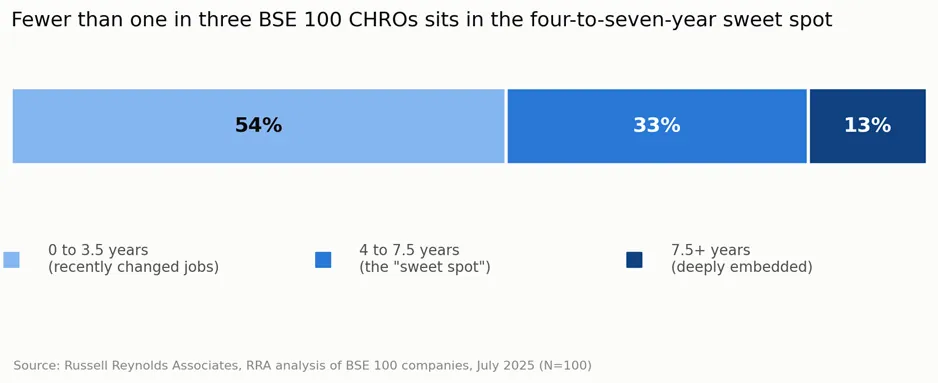
Internal succession, done with real breadth. It would be dishonest to turn this into a pure case for external hiring, because some of the strongest Indian examples run the other way. In March 2025, TCS elevated Sudeep Kunnumal, with the company since 2000, to CHRO designate after he had led HR for its largest revenue segment (BFSI) and built leadership experience across North America, Europe and Asia-Pacific. That is not “promoting someone from HR.” That is a company building an enterprise leader through twenty-five years of deliberately varied exposure inside one payroll. Wipro’s Saurabh Govil has led HR there since 2008, a remarkable run of stability in a sector where the BSE 100 data shows some of the fastest CHRO churn. What that tenure conceals is that Govil arrived at Wipro already carrying HR leadership experience from ICICI and GE Capital, two organizations with almost nothing in common. And in February 2026, Tata Projects elevated Shirly Burla to CHRO, an internal promotion within the company, but one built on more than two decades of prior HR leadership across Siemens and the Shapoorji Pallonji Group before she ever joined Tata Projects in 2023. Every one of these three “internal” successions was really an internal promotion of someone who had already accumulated the outside range the treadmill problem says a pure company lifer lacks.
Succession planned, and succession skipped. Mahindra & Mahindra named Rohit Thakur as the next Group CHRO more than a year ahead of Ruzbeh Irani’s planned retirement in April 2026, exactly the kind of proactive planning Russell Reynolds says is rare across the BSE 100. Infosys, by contrast, moved through 3 HR leaders in quick succession, from Krish Shankar to Richard Lobo to Sushanth Tharappan, inside a few years, at a company mature enough that the churn is hard to explain as bad luck. It reads instead as an unresolved argument about what the CHRO role there is actually meant to do.
The treadmill problem exists at board level too
This is the uncomfortable part, and it isn’t unique to India. An organization can replace CHRO after CHRO and believe it’s solving the problem. But if every incoming CHRO inherits the same mandate, the same constraints, the same decision rights, then the organization isn’t transforming its people function. It’s rotating people through an unchanged system, which is the corporate equivalent of a new runner stepping onto the same treadmill.
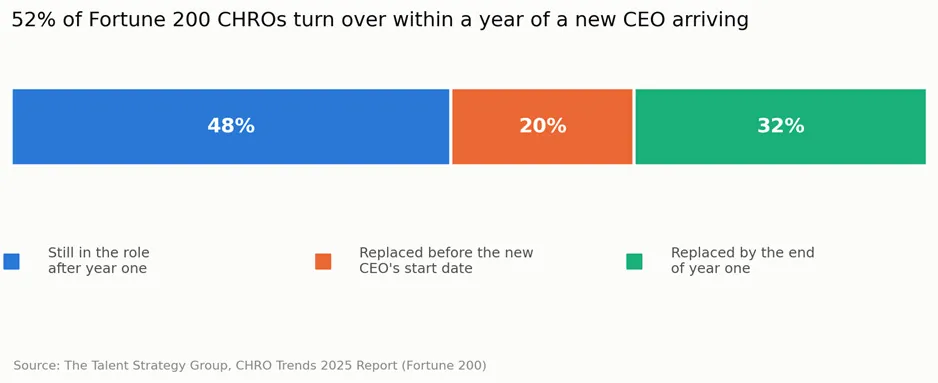
The Talent Strategy Group’s Fortune 200 research gives this a hard number. 52% of CHROs turn over within the first year of a new CEO’s arrival, split between 20% replaced before the new CEO even officially starts and a further 32% replaced by the end of year one. When a new CEO looks at the sitting CHRO and effectively asks “can you help me change this place,” and the honest answer is “I know this place better than anyone,” those are not the same answer, and a lot of CHRO departures are exactly that mismatch playing out.
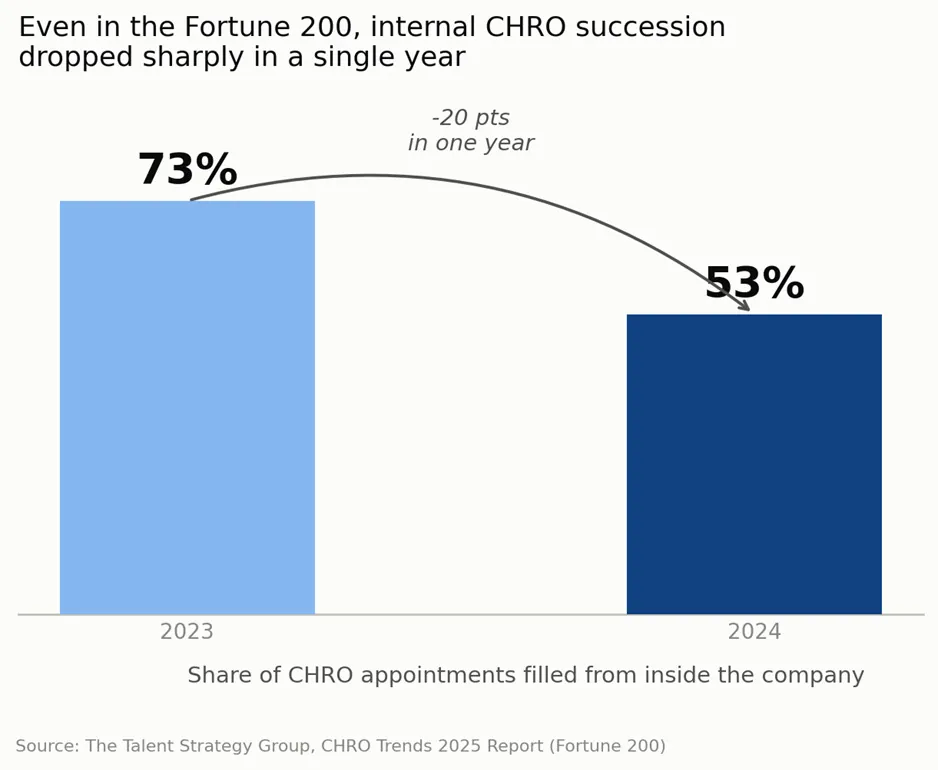
More striking still, the same research shows this dynamic has been getting worse even in the world’s most resourced HR functions. Internal CHRO succession across the Fortune 200 fell from 73% in 2023 to just 53% in 2024, a twenty-point drop in a single year. That is not an India story. That is the same structural tension, mandate versus authority, showing up in American boardrooms with mature succession processes and much larger HR budgets than most BSE 100 companies have. It suggests the internal-versus-external question was never primarily a maturity gap India needs to close. It’s a design tension every board eventually runs into.
The most dangerous CHRO, in other words, is neither the internal one nor the external one. It’s the one whose accountability is larger than their authority: expected to transform culture, build the leadership pipeline, improve productivity, hire faster, and implement AI, all at once, without board visibility, a transformation budget, or the standing to challenge the CEO. Replace that person with someone new and, if the mandate doesn’t change, you’ve replaced one passenger on the same train.
Five questions that matter more than “internal or external”
1. What is the business actually asking the CHRO to accomplish: continuity, or transformation? Those are different assignments requiring different profiles, and naming which one it is, honestly, is the first decision a board skips.
2. Does the organization need institutional knowledge, or outside pattern recognition? If the business is stable and its culture is a genuine advantage, internal is usually right. If it’s wrestling with restructuring, M&A, digital disruption, or a leadership failure that has repeated itself, external experience carries more weight.
3. How much breadth does the internal candidate actually have? The useful question is never “how many years have they been here.” It’s how many genuinely different problems, business units, geographies or crises they’ve been forced to solve. Kunnumal, Govil and Burla all show that one company can contain enough different learning environments to build real range, if the person was deliberately rotated through them.
4. Is the external candidate bringing transferable experience, or just a bigger name? A CHRO from a famous company is not automatically a transformation leader. The useful diligence question is concrete: what did they personally change, what was the starting condition, what resistance did they meet, what was the measurable outcome, and can any of that actually transfer here.
5. What is this CHRO supposed to leave behind when they go? If an external hire is brought in because the internal bench lacks a specific capability, the point of the mandate should include building that capability into two or three internal successors, not creating permanent dependence on the external market. External CHRO, transformation, capability building, internal succession, is a far more powerful sequence than treating the external hire as a permanent fixture.
A simple model for making the decision
Diagnose first: does the business need continuity, transformation, or (the most common answer) transformation with continuity. Then benchmark internally, not against other HR leaders, but against what the business will actually need in three to five years. Then benchmark externally too, even if the board expects to promote from within, because it tells you what “good” looks like and either exposes a real gap or confirms your internal candidate is genuinely strong. Make the call based on the gap: if the internal candidate already has business understanding, transformation experience, enterprise credibility and some version of outside perspective, hiring externally would be solving a problem that doesn’t exist. If the internal candidate has institutional knowledge and HR expertise but the business needs disruption and cross-industry pattern recognition, hiring externally is the more responsible decision, provided the mandate explicitly includes building the next internal successor.
Where I land
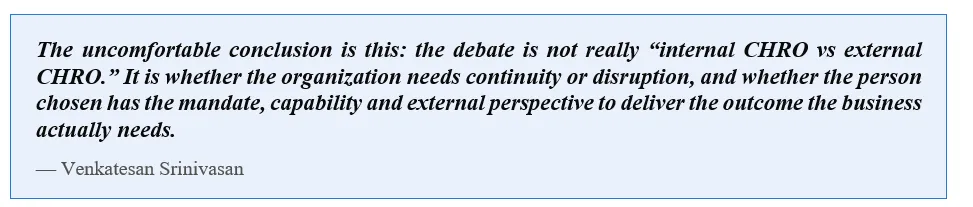
Should the CHRO be built from within? Yes, when the organization needs continuity and has a genuinely strong internal successor. Not automatically, when it needs a kind of transformation the existing system has already tried and failed to deliver on its own. And often, the better answer is a third option: bring someone in from outside, but write building the internal successor into their mandate from day one, so the company isn’t permanently renting the capability it needs.
None of this resolves into “always promote from within” or “always hire fresh blood.” Both of those are slogans, not strategies. The real failure was never choosing the wrong side of that debate. It’s expecting a different result while quietly keeping everyone, insider or outsider, on the same treadmill: same authority, same constraints, same unwritten rules about how far change is allowed to go. Change the runner as often as you like. Until the track itself changes, the distance covered stays exactly zero.
AUTHOR:
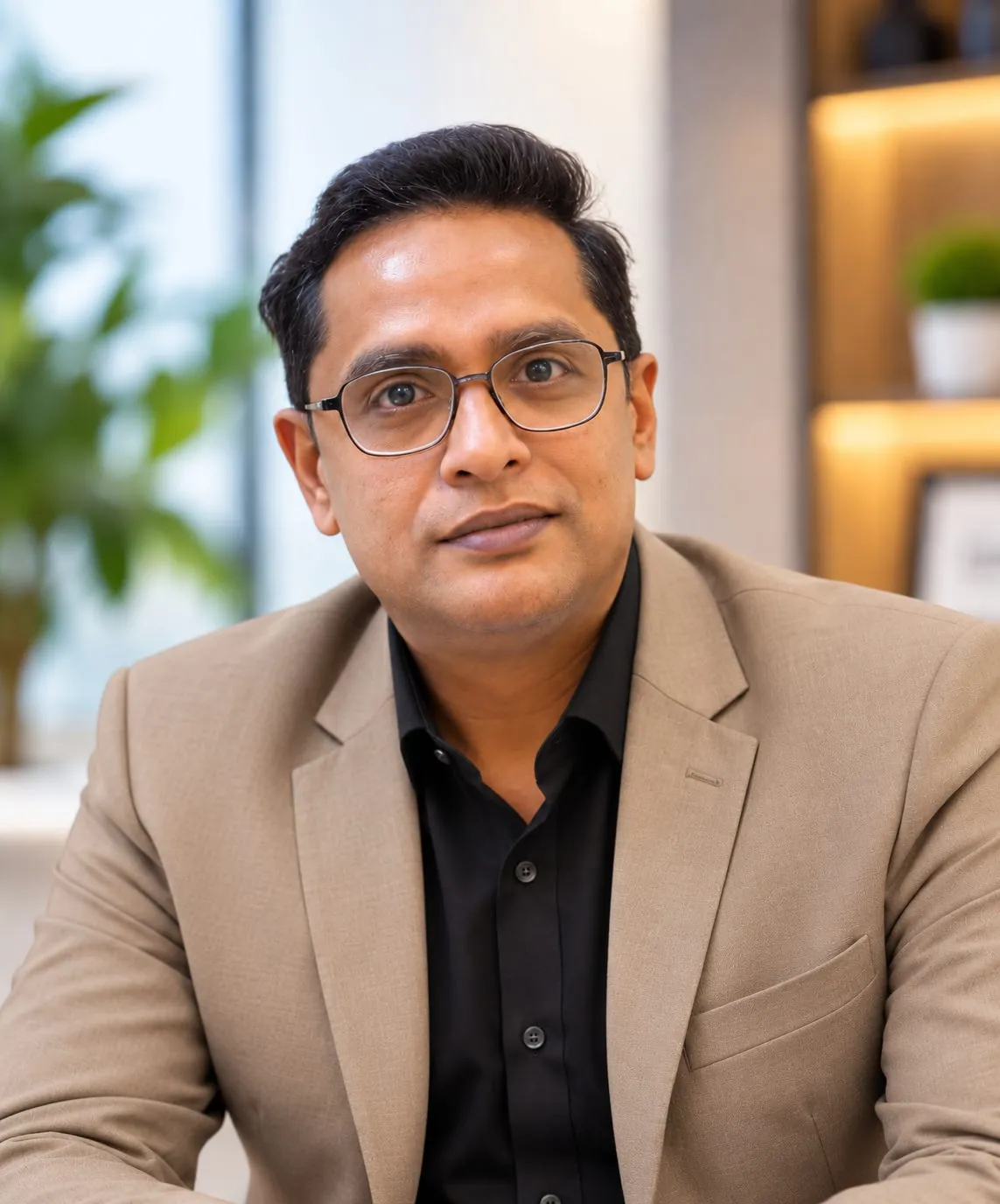
Venkatesan Srinivasan (Venkat)
Founder, VS GenX Solutions
Venkat is an HR transformation practitioner with 20+ years of experience across technology, fintech, telecom, product development and Global Capability Centers, with a particular focus on helping growing organizations build people systems that can scale with their ambitions.
He founded VS GenX Solutions around a simple conviction: HR should not merely support business, but should help shape how people, purpose and progress come together. His work spans HR transformation, leadership development, AI-driven HR automation and building inclusive, future-ready workplaces for startups and SMEs.
His larger purpose extends beyond consulting: to create sustainable growth opportunities for talented individuals from underprivileged communities across India, with VS GenX Solutions committing 5% of its earnings towards this cause.
Connect with Venkat
Email: enablement@vsgenxsolutions.com
Website: www.vsgenxsolutions.com
People | Purpose | Progress
References
1. Bahl, K., Huntington, A., Katara, V., & Patel, K. “The Battle for CHRO Talent in India.” Russell Reynolds Associates, July 2025. russellreynolds.com/en/insights/reports-surveys/global-chro-turnover-index
2. Russell Reynolds Associates. “Q1 2025 Asia CHRO Turnover Trends & Leadership Insights.” russellreynolds.com/en/about/newsroom/q1-2025-asia-chro-turnover
3. “Global CHRO turnover up in 2025 amid need for organizational alignment.” Human Resources Director, HCAMag. hcamag.com/us/.../global-chro-turnover-up-in-2025
4. “The context trap: Why your CHRO’s experience doesn’t transfer.” HR Katha. hrkatha.com/.../the-context-trap
5. “The CHRO’s New Mandate.” Hunt Scanlon Media. huntscanlon.com/the-chros-new-mandate
6. “How Insider CEOs Succeed.” Harvard Business Review, March 2020. hbr.org/2020/03/how-insider-ceos-succeed
7. “How GE CEO Larry Culp pulled off the turnaround of the century.” Fortune. fortune.com/.../larry-culp-turnaround
8. “Culture transformation at Microsoft: An ongoing journey.” HR Executive. hrexecutive.com/why-microsofts-culture-transformation-is-continuous
9. “This HR Executive of the Year is Transforming IBM” (Diane Gherson). HR Executive. hrexecutive.com/this-hr-executive-of-the-year-is-transforming-ibm
10. “Fit for the postpandemic future: Unilever’s Leena Nair on reinventing how we work.” McKinsey & Company. mckinsey.com/.../leena-nair
11. “Chanel CEO Leena Nair, from Unilever CHRO to luxury top job.” Business Chief. businesschief.com/.../unilever-chro-to-chanel-ceo-leena-nair
12. “Meet Wipro’s Chief HR Officer, Saurabh Govil.” Wipro. wipro.com/leadership/saurabh-govil
13. Johnson Controls. “Johnson Controls Appoints Chris Scalia as Executive Vice President and Chief Human Resources Officer.” July 2025. johnsoncontrols.com/.../chris-scalia
14. TransUnion Newsroom. “TransUnion Appoints Alicia Zuiker Chief Human Resources Officer.” June 2025. newsroom.transunion.com/.../alicia-zuiker
15. “Walmart’s Flipkart appoints former Reliance executive Seema Nair as CHRO.” Business Standard. business-standard.com/.../seema-nair-as-chro
16. “TCS confirms Sudeep Kunnumal as new CHRO in major leadership transition.” People Matters. peoplematters.in/.../sudeep-kunnumal
17. “Tata Projects elevates HR leader Shirly Burla to CHRO role.” People Matters. peoplematters.in/.../shirly-burla
18. “Tata Motors appoints D P Nambiar as CHRO amid transformation push.” People Matters. peoplematters.in/.../dp-nambiar
19. “HDFC Bank appoints Vibhash Naik as its new CHRO from February 2026.” People Matters. peoplematters.in/.../vibhash-naik
20. “Another C-suite reshuffle at Infosys; Sushanth Tharappan to replace current HR head Richard Lobo.” Business Today. businesstoday.in/.../richard-lobo
21. “Mahindra & Mahindra Appoints Rohit Thakur as Group CHRO as Ruzbeh Irani to Retire in April 2026.” Angel One. angelone.in/.../rohit-thakur
22. The Talent Strategy Group / CHRO.org. “Internal CHRO Successions Dropped Considerably in 2024,” summarising the CHRO Trends 2025 Report (Fortune 200 data). chro.org/w/internal-chro-successions-dropped-considerably-in
Originally published on Venkat's Substack. Subscribe for free to receive new articles.