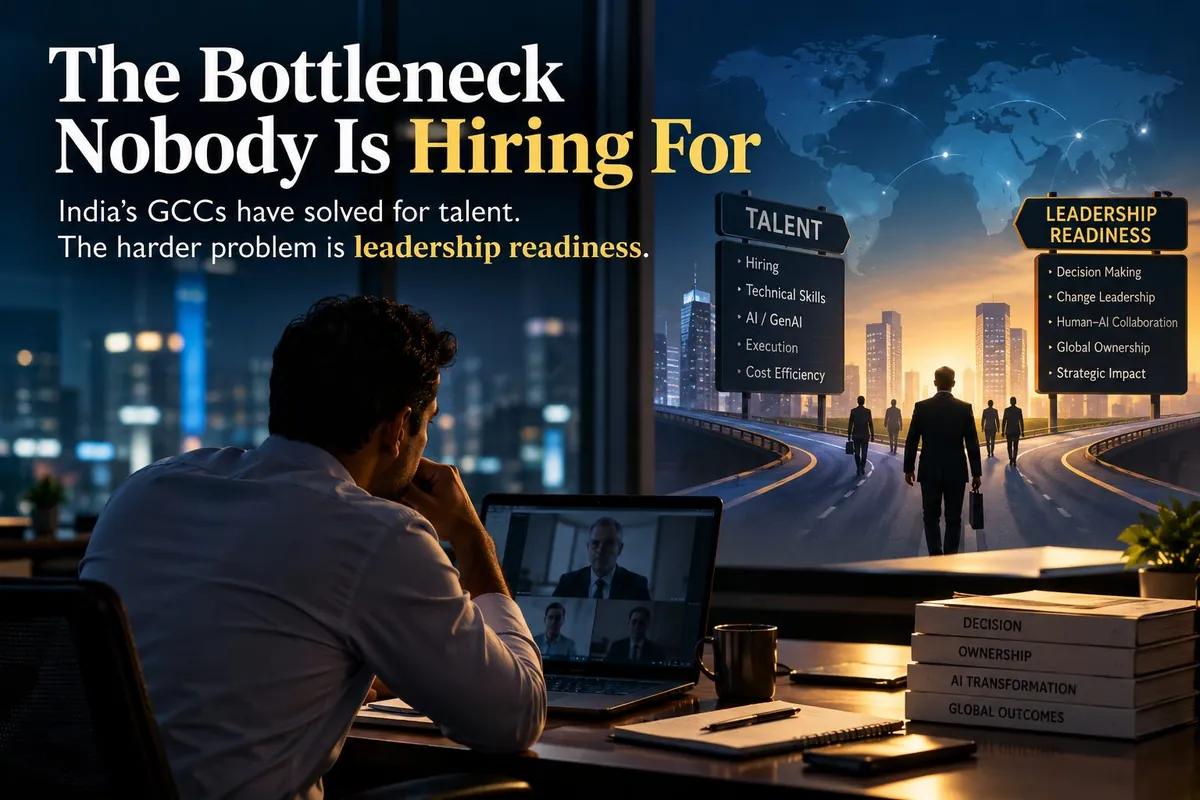
10:40 PM, Hyderabad
(A fictional scene, though anyone who works in a GCC will recognize it.)
Karthik had been a Vice President for a month now.
For fourteen years he had been the person who delivered. Releases went out on time. Defects went down. Attrition on his teams stayed below the site average. When the US parent decided to move global ownership of its claims platform to India, his name came up first and nobody debated it.
On the late-night call, the Chief Operating Officer in Chicago looked straight into the camera and said, “Karthik, a regulator in Ohio has flagged something in our claims logic. Do we pause the AI triage model tonight or keep it running? It’s your platform. What’s your call?”
Karthik did what had always served him well. “Let me get the team together, check the data, and come back to you tomorrow.”
There was a pause just long enough to register.
The next morning his US-based mentor sent him a short message: “We didn’t move the platform to India so India could ask us for permission. We moved it so India could decide.”
Karthik was not short on talent, intelligence, or commitment. What he lacked was readiness. No one had ever asked him to practice being the person who makes the decision.
I believe that gap is where India’s GCC story will be won or lost.
The numbers are loud
On scale, there is no longer any debate. The latest Nasscom-Zinnov landscape report puts India at 2,117 GCC’s running 3,728 units and employing roughly 2.36 million professionals as of FY26. The count has risen 32% since FY2021, and about 506 Forbes Global 2000 companies now operate from the country. More than 1,200 of these centers have AI/ML capabilities, backed by over 250,000 AI/ML professionals.
The mandate has changed just as quickly. At the NASSCOM GCC Summit this year, the dominant theme was that global companies are handing their India centers far more responsibility, from product ownership and AI-led transformation to business decisions and global leadership mandates. Zinnov calls one of the structural shifts of FY2026 the migration of enterprise authority to India-based leaders.
You can see the arc in five lines:
From execution → ownership.
From support → strategy.
From cost arbitrage → capability creation.
From delivering work → owning global outcomes.
And AI is compressing all of it into a few years.
This is the story we tell at conferences, and it is true.
However, there is yet another story in the same data that gets far less stage time.
The numbers are quiet
This August, PwC India and FICCI surveyed 200 senior GCC executives. Their finding: AI ambition in GCC’s is running ahead of leadership readiness. Senior leaders average just 27% on AI literacy, and more than 90% of GCC’s say their leadership teams are not yet AI-literate enough for strategic decisions.
The detail that caught my attention was not technical. The largest deficits were in change management for AI-driven workforce transformation (58%), human–AI teaming (54%) and enterprise-wide AI strategy (45%). Put simply, these are leadership skills, not coding skills.
The same study found 52% naming a shortage of senior leaders with AI-era strategic capabilities as a key supply constraint. It also found that new hires need an average of 8.69 months to become fully productive.
Other data points the same way. EY’s GCC Pulse Report found that nearly 80% of centers have under 10% of their leadership roles based in India, and that leadership pipelines are not keeping up with rapid expansion. Industry estimates project global leadership roles rising from 6,500 to 30,000 by 2030.
That is roughly 23,500 new global leaders in four years. You cannot hire them all from the outside, because they do not exist yet. Most of them are in your building right now, doing jobs like Karthik’s.
And where are GCC’s putting their hiring energy? A Ceipal and People Matters study found GCC’s prioritizing Gen AI and prompt engineering (66%), data science (58%) and AI/ML engineering (50%), while under-investing in program leadership (26%) and product management (22%).
We are buying the engine and neglecting the driver.
Why promoting your best people is not enough
Here is the uncomfortable pattern I have seen repeatedly over two decades: the best engineer becomes the manager, the best manager becomes the site head, and the best site head gets the global mandate. At each step, we reward what the person has done and assume it predicts what they will need to do.
Gallup’s research has challenged this assumption for years. It finds that companies fail to choose the candidate with the right talent for the job 82% of the time. When Gallup asked managers why they got the role, they most often pointed to success in a previous non-managerial role or their tenure.
So let me restate the equations from my original post, because I believe them more after the research, not less:
Technical excellence ≠ strategic leadership.
Managing a large team ≠ leading through ambiguity.
Being good at execution ≠ being ready to own a global business outcome.
Attending a leadership program ≠ becoming leadership-ready.
Yesterdays GCC leader managed delivery, productivity, quality, cost and people. On the other hand, tomorrows’ leaders’ will manage ambiguity, global stakeholders, AI-human collaboration, cross-functional ownership, faster decisions, continuous change and business outcomes.
That is not a bigger version of the old job. It is a different job.
Five questions that reveal readiness
When I assess whether a leader is ready for what comes next, I don’t start with their CV. I start with these five questions.
1. Can they make decisions without waiting for permission?
This was Karthik’s test, and it is the first one most newly elevated leader fail. For years, a GCC’s culture rewarded escalation: when in doubt, check with HQ. Ownership turns that reflex into a liability. A useful signal: when the data is 70% complete, does this person decide, or ask for more data?
2. Can they influence stakeholders they don’t control?
Global mandates put India-based leaders in rooms with peers in Frankfurt, Chicago and Singapore who don’t report to them and never will. Authority from the Organization chart no longer carries you. Credibility, framing and relationships built over time do. A good real example of how far this can go is Ashish Grover, who joined Chilean retailer Falabella in 2018 to lead its technology center in India and became global CIO within three years. That doesn’t happen through delivery alone.
3. Can they lead people through uncertainty rather than simply explain the change?
Explaining change is a communication skill. Leading people through it is an emotional and behavioral one. When AI reshapes roles, teams don’t need a better slide. They need a leader who can say “I don’t know everything yet, and here is what we will do anyway,” and still be trusted. Remember that PwC’s biggest leadership gap was change management for AI-driven transformation.
4. Can they connect technology and AI to business outcomes?
Many GCC leaders can explain how a model works. Fewer can explain what it’s worth to a CFO in the parent company. As Zinnov’s Nikita Goel put it at this year’s awards, the edge is shifting away from talent at scale or cost toward the ability to create disproportionate enterprise value. A leader who can’t speak the language of revenue, risk and customer outcomes will stay a technology manager, however senior the title.
5. Can they build leaders below them instead of becoming the bottleneck?
The irony of high performers is that they are often the reason their teams don’t grow. They step in, fix the problem and protect the deadline, and in doing so they quietly teach everyone to wait for them. The real test of a GCC leader in 2030 will be how many people underneath them can make the decision without them.
Building readiness deliberately
The good news is that readiness can be built. But it has to be designed, not left to chance or a two-day offsite.
Money is starting to follow. Most GCC’s currently spend 3–5% of operating budgets on talent development, and 94% believe that should rise to at least 6%. The question is what that money should buy. From my work with leaders across India, US, UAE and Southeast Asia, a few things consistently make the difference:
Assess before you elevate. Use simulations that put people in Karthik’s 10:40 PM moment before it happens for real. How someone behaves under pressure tells you more than a decade of appraisal ratings.
Rehearse, don’t just teach. Leadership is a performance skill. Leaders need a safe stage to practice difficult conversations, stakeholder pushback and decisions under ambiguity, the same way actors rehearse before opening night.
Grant decision rights gradually and on purpose. Give emerging leaders real, bounded decisions early, with a debrief afterward. Ownership is a muscle, and it only develops under load.
Measure leaders by the leaders they create. Make successor readiness a scorecard item, not a footnote.
Back to Karthik
Six months later, the same COO asked Karthik a harder question about a different model on a different night.
This time he answered in four minutes. He laid out the risk, the options and his recommendation, and he said what he would do if he turned out to be wrong. Then he added something that surprised everyone on the call: “My platform lead, Divya, pressure-tested this with me an hour ago. She will own the rollback plan.”
Nothing about his intelligence had changed. His readiness had. Someone had finally invested in helping him practice the job he’d been promoted into.
The question I’d leave with every GCC CEO and CHRO
After more than 25 years of watching Organizations transform, my biggest lesson is this: transformation rarely stalls because people don’t understand the strategy. It stalls because leadership behavior hasn’t caught up with it.
The next competitive advantage for GCC’s may not be “How many people can we hire?”
It may be “How many leaders can we create who are capable of owning what comes next?”
So here is the point to think:
Are you building talent for today’s GCC, or leaders for the GCC you want five years from now?
I suspect the answer will decide who builds the next generation of global capability centres.
If this resonated, I’d love to hear from you: which of the five questions do your leaders struggle with most?
AUTHOR:
Venkatesan Srinivasan (Venkat)
Founder, VS GenX Solutions
Venkat is an HR transformation practitioner with 20+ years of experience across technology, fintech, telecom, product development and Global Capability Centers, with a particular focus on helping growing organizations build people systems that can scale with their ambitions.
He founded VS GenX Solutions around a simple conviction: HR should not merely support business, but should help shape how people, purpose and progress come together. His work spans HR transformation, leadership development, AI-driven HR automation and building inclusive, future-ready workplaces for startups and SMEs.
His larger purpose extends beyond consulting: to create sustainable growth opportunities for talented individuals from underprivileged communities across India, with VS GenX Solutions committing 5% of its earnings towards this cause.
Connect with Venkat
Email: enablement@vsgenxsolutions.com
Website: www.vsgenxsolutions.com
People | Purpose | Progress
References
Nasscom–Zinnov, GCC Value Orbit: From Delivery Engine to Enterprise Nerve Centre (GCC Landscape Report 2026), via PR Newswire/Yahoo Finance, July 2026. https://finance.yahoo.com/technology/ai/articles/india-gccs-increasingly-leading-ai-055700455.html
Zinnov, Zinnov-Nasscom India GCC Landscape 2026 Report. https://zinnov.com/centers-of-excellence/zinnov-nasscom-india-gcc-landscape-2026-report/
PwC India–FICCI, Navigating the Skills Imperative for India’s GCCs in the AI Era, August 2026. https://www.pwc.in/services/global-capability-centre-gcc/navigating-the-skills-imperative-for-india-s-gccs-in-the-ai-era.html
MediaBrief, “PwC India-FICCI: India’s GCCs in the AI era,” August 2026. https://mediabrief.com/pwc-india-ficci-indias-gccs-in-the-ai-era/
SME Street, “PwC India-FICCI Study Highlights GCC Skills Gap in AI Era,” August 2026. https://smestreet.in/sectors/pwc-india-ficci-study-highlights-gcc-skills-gap-in-ai-era-12256478
inkl, “90% of India’s GCC leaders confident through 2030, but AI literacy stuck at 27%,” August 2026. https://www.inkl.com/news/90-of-indias-gcc-leaders-confident-through-2030-but-ai-literacy-stuck-at-27
VARINDIA, “India’s GCC Expansion Faces Leadership Talent Crunch” (citing EY GCC Pulse Report 2025), May 2026. https://www.varindia.com/news/India%E2%80%99s-GCC-Expansion-Faces-Leadership-Talent-Crunch
V3 Staffing, “India GCC List 2026,” August 2026. https://v3staffing.in/blog/india-gcc-list
Ceipal and People Matters, GCC Talentscope India 2026 Report, March 2026. https://www.ceipal.com/resources/ceipal-people-matters-gcc-report-2026
GCC Pulse, “At NASSCOM GCC Summit 2026, India’s GCC Story Shifted From Scale to Ownership,” May 2026. https://gcc-pulse.com/gcc-news/trends-insights/at-nasscom-gcc-summit-2026-indias-gcc-story-shifted-from-scale-to-ownership/
The Tribune / Business Standard, “Zinnov Awards 2026 Recognise GCCs Shaping Enterprise Outcomes in the AI Era,” August 2026. https://www.tribuneindia.com/news/business/zinnov-awards-2026-recognise-gccs-shaping-enterprise-outcomes-in-the-ai-era/amp/
Zinnov, 5 Trends Redefining GCCs 2024 (Falabella / Ashish Grover example). https://www.scribd.com/document/800511162/Gcc
Gallup, “Why Great Managers Are So Rare.” https://www.gallup.com/workplace/231593/why-great-managers-rare.aspx
Gallup, “Managers Account for 70% of Variance in Employee Engagement.” https://news.gallup.com/businessjournal/182792/managers-account-variance-employee-engagement.aspx
Originally published on Venkat's Substack. Subscribe for free to receive new articles.