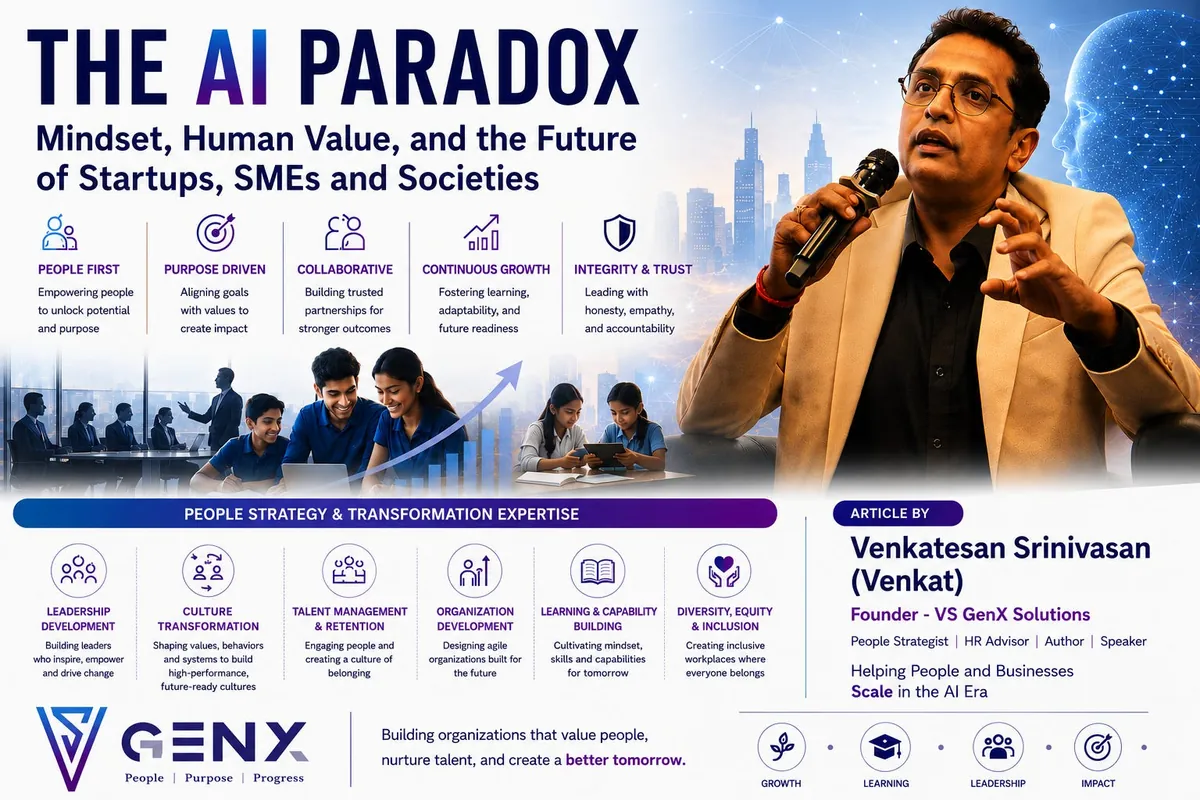
AI can produce, but it cannot consume. It cannot want, cannot buy, and cannot be the last customer. This is a research backed look at the paradox sitting under the AI economy, what it means for startups and SMEs across India, SriLanka and the Gulf, and which of the proposed solutions are actually practical. A fictional founder runs through it to keep the argument honest.
Chapter 1: A scene playing out in a thousand offices
Roshan Singh ran a forty person customer experience firm out of Pune’s Hinjewadi belt, with a small delivery team in Colombo and one anchor client in Dubai. For eleven years the model was simple. People answered people, and at the end of every month the invoices cleared.
Then, on a humid Tuesday in early 2026, his largest client sent a one line note. “We are consolidating support onto an AI platform. We will need 60 percent fewer seats from Q3.” The platform could already resolve most routine queries on its own, the way automated systems were quietly resolving the bulk of customer enquiries across the industry without a human ever touching them.
Roshan did the arithmetic on a notepad. Do nothing and lose the contract within a year. Match the client, automate his own floor, keep the margin, and let go of two thirds of his team. And then the thought that kept him awake: the people he would let go were also, somewhere down the chain, somebody’s customers. If everyone in his position did the same thing at the same time, who exactly would be left to buy anything?
Roshan had stumbled, on a notepad, into one of the deepest paradoxes of our time. By the end of this essay he will have found his way through it, and so, hopefully, will you.
Chapter 2: The tsunami is real, and so is the theater around it
Let us be honest about the water level before we talk about the boat.
The fear is not imagined. Employee anxiety about AI driven job loss has risen from roughly 28 percent in 2024 to around 40 percent in 2026,¹ according to a large global workforce study. At this year’s World Economic Forum gatherings, AI layoffs were the dominant theme, and the IMF’s managing director warned bluntly that most countries and most businesses are simply not prepared.
The numbers are substantial. Tech layoffs in early 2026 ran well ahead of the previous two years, with around 80,000 roles cut in the first quarter alone² and the cumulative total climbing past 140,000 by late May.³ Stanford’s 2026 AI Index found employment for software developers aged 22 to 25 had fallen nearly 20 percent since 2024, the exact window in which generative AI went mainstream. Research from Anthropic pointed the same way, with the job finding rate for young workers in highly exposed roles down around 14 percent⁴ against 2022. Customer support, Roshan’s own business, has been among the hardest hit,⁵ because automated systems now resolve the large majority of routine enquiries. The Boston Consulting Group has projected that up to 15 percent of US jobs⁶ could be eliminated over the next five years, and the World Economic Forum’s Future of Jobs projections point to tens of millions of roles displaced even as new ones are created.
But here is the part serious founders must grasp, because it changes the response. A meaningful share of these cuts is not pure technological displacement. It is what insiders now call “AI washing.” The head of one major AI lab admitted publicly³ that some firms are blaming AI for layoffs they wanted to make anyway, while confirming that real displacement is also happening and the two are hard to separate from outside. Several of the biggest cuts, at already profitable companies, were openly about freeing payroll to fund enormous AI infrastructure bills, not about AI already doing the work.
Why does this matter to an SME owner in Vijayawada, Colombo, Nigeria or Sharjah? Because if part of the wave is fashion and fear rather than fact, the founders who keep their nerve and augment their people instead of dismissing them in a panic will inherit both the talent and the trust the herd is throwing away.
Chapter 3: The paradox Roshan found on his notepad
Roshan’s late night arithmetic has a respectable name. It is the paradox of under-consumption, and in 2026 it stopped being a textbook curiosity and started appearing in the work of central bank economists and serious researchers.
The logic is uncomfortable because it is so simple. A business replaces workers with AI, costs fall, margins rise. Good for that business. But wages are not only a cost on a spreadsheet. Wages are the income that lets people buy things. When one firm does this, nothing breaks. When every firm does it at once, displaced workers stop spending, aggregate demand shrinks, and the firms that lost those customers respond by cutting further, usually through more automation. Layoffs reduce demand, falling demand triggers more layoffs, and the loop feeds itself.
Two economists modeled exactly this feedback loop in a 2026 paper and concluded that, at the extreme, firms automate their way to enormous productivity and almost no demand.⁷ A widely discussed scenario from an investment research firm sketched a near future in which AI displacement pushes unemployment above 10 percent⁸ and consumer demand collapses with it. Economists at the New York Federal Reserve noted that consumption lost by displaced workers⁹ may only be partly replaced by the gains of those AI makes more productive, especially since the winners tend to save more. The distribution makes it sharper: in advanced economies the top fifth of earners already account for the majority of consumer spending,¹⁰ so an economy that hollows out its middle¹¹ is quietly hollowing out its own marketplace.
This is the catch 22, stated as a chain, the way Roshan eventually drew it on his office whiteboard:
Without people, there is no talent. Without talent, there is no innovation. Without innovation, there is no AI. Without AI, there is no new business. Without business, there is no economy. Without an economy, there is no growth for any nation.
AI does not eat. It does not desire. It does not take its family out for biryani on a Sunday or save for a child’s wedding. It can produce, but it cannot consume. Strip enough purchasing power out of the population and the most sophisticated AI driven company in the world ends up selling to an empty room. That is the room Roshan was afraid of, and it is the room every founder, knowingly or not, is helping to fill or to empty.
Chapter 4: The map is not flat, it is a battlefield
A second force presses on every founder in India, SriLanka and the Gulf, and it is geopolitical.
AI maturity is now an instrument of state power and is being wielded as one. The advanced chips that train and run frontier models sit at the center of an open contest between the major powers, governed by export controls, licensing regimes and tiered access frameworks¹² that sort nations into categories of trust. The fight over which countries may even buy the most advanced chips¹³ has become a recurring flashpoint between Washington and Beijing.¹⁴ Smaller and developing economies have gained a seat at the new governance tables but remain structurally dependent on the few powers that control the compute, the capital and the talent. When AI becomes a lever of national strategy, access to it stops being purely commercial and becomes a question of which side of a line your country sits on.
This is not abstract for our region. India has answered with sovereign ambition, backing its national AI mission with over ten thousand crore rupees¹⁵ and a framework positioning AI as an engine for a developed India, while building digital public infrastructure and language tools that let products work across many tongues and literacy levels. The Gulf has gone further and faster with capital. Saudi Arabia formally designated 2026 its Year of Artificial Intelligence¹⁶ and targets AI contributing around 12 percent of GDP by 2030,¹⁷ while the UAE pours billions into becoming an AI native government and financial center, with Dubai’s financial district alone targeting 25,000 new AI related jobs.¹⁸
The lesson is double edged. You are building on infrastructure whose availability is now subject to politics far above your pay grade, so resilience and optionality matter more than ever. Yet sovereign AI strategies also create enormous downstream demand for local talent, context, compliance, trust and the deeply human work of adoption. The giants build the engines. Somebody local still has to drive, service and translate them for real customers. That somebody can be you.
Chapter 5: Roshan was asking the wrong question
When Roshan first sat with his team, the smartest person in the room asked what felt like the smartest question: “What is the 10 percent of our work that AI will never be able to do, so we can defend it?”
It is the same question a senior banker put to Marco Argenti, the Chief Information Officer of Goldman Sachs, in a June 2026 essay for the Harvard Business Review.¹⁹ And Argenti’s answer reframes this entire debate.
He offered an analogy. Picture an expert horse rider who now has to learn to drive a car. Which of their horse riding skills should they cling to? Almost none of them transfer directly. But that does not make the rider a beginner. What transfers is the deeper layer: the reflexes, the spatial instinct, the judgement of speed and distance, the calm under motion. The task is not to preserve a shrinking 10 percent of the old craft. It is to carry the underlying 100 percent of one’s instincts into an entirely new vehicle. Argenti’s conclusion, and the title of his piece, is that thriving alongside AI is a matter of mindset, not skillset. Do not merely reskill, he argues. Reimagine the role and build new habits.
This lands hard on Roshan’s notepad problem, because it explains why so many reskilling efforts feel hollow. Teaching a support agent to write better prompts is reskilling. It defends a sliver. Helping that same agent see themselves as the person who owns the customer relationship, exercises judgement on the hard cases, supervises a fleet of AI agents and takes accountability when something breaks, that is a new mindset poured into a new role. The skill list will keep changing every six months. The mindset, the adaptive instinct, is the thing that compounds.
So Roshan stopped asking his team to defend their 10 percent. He started asking them to reimagine their 100 percent. That single shift, from skillset to mindset, is the hinge on which every practical solution below actually turns. A tool given to a defensive mind protects a shrinking patch. The same tool given to an adaptive mind opens a new road.
Chapter 6: The menu of solutions, and how practical each one really is
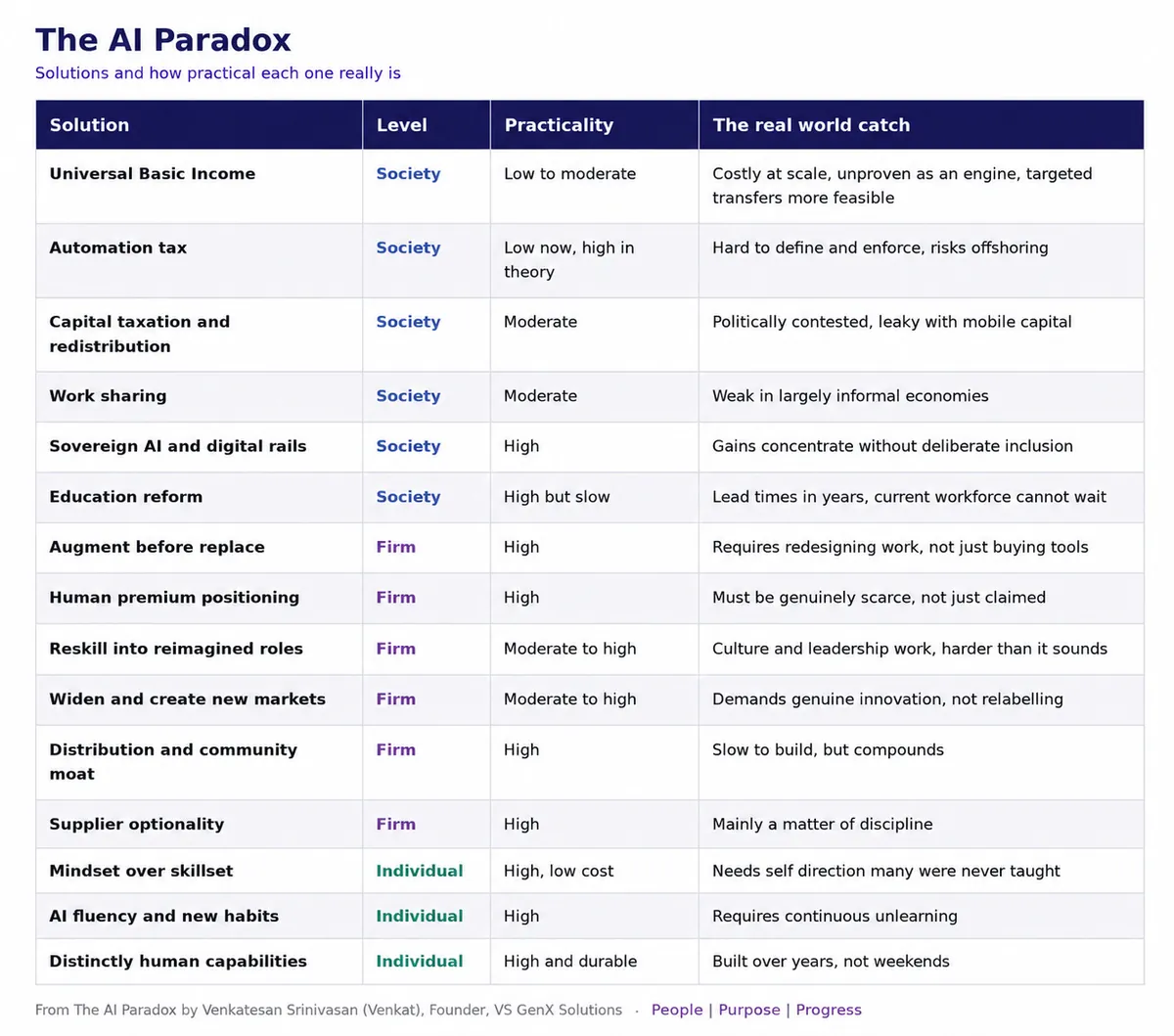
Everyone offers solutions. Few are honest about how well they work. Below are the realistic options at three levels: what societies can do, what firms can do, and what individuals can do. For each I give a plain practicality verdict, because a strategy essay that pretends every fix is easy is not a strategy essay, it is a brochure.
Level one: society and policy
These are the levers that address the demand paradox itself. None is in your control as a founder, but they shape the weather you operate in.
Universal Basic Income. Pay everyone a floor regardless of work, so consumption survives even if wages do not. Practicality is low to moderate in the near term. Pilots have shown modest well-being gains but no proof it sustains an economy at scale, and in the very model that diagnosed the automation trap, basic income alone was not enough to stop the collapse. For India and SriLanka the fiscal weight at full scale is enormous, though targeted direct cash transfers, which India already runs through its digital rails, are a far more feasible cousin of the idea.
An automation or robot tax. Charge firms for each human role displaced by AI, so they carry the social cost of the demand they destroy. In the academic model this was the one lever that actually worked. In the real world its practicality is low for now, because defining what counts as an AI replacement is a nightmare, enforcement is leaky, and a single country trying it risks pushing investment offshore. It matters more as a principle, that productivity gains carry a social bill, than as a policy you should expect soon.
Taxing capital and redistributing the AI surplus. As AI shifts income from labor to capital, tax what capital earns and recycle it. Practicality is moderate. It uses tax machinery that already exists rather than inventing a new one, which is its advantage, but global capital mobility and political resistance make it leaky and slow.
Work sharing and shorter working weeks. Spread the available work across more people rather than concentrating it and discarding the rest. Practicality is moderate in formal, organized sectors, where short time schemes have cushioned past downturns, but weak across the largely informal labor markets of South Asia, where most people are not on the kind of contract that work sharing assumes.
Sovereign AI and public digital infrastructure. Governments invest directly in compute, models, skills and inclusive digital rails, creating both capability and downstream jobs. Practicality is high, because it is already happening across India and the Gulf, and it is the policy lever most visible in our region. The catch is distribution. Sovereign investment creates a multiplier of high value roles, but those gains concentrate unless paired with deliberate inclusion of smaller firms and ordinary workers.
Education and lifelong learning reform. Rebuild schooling and adult learning around adaptability rather than fixed skills. Practicality is high in direction and unavoidable in the long run, but painfully slow, with lead times measured in years and a generation already in the workforce who cannot wait for the school system to catch up.
The honest summary at this level: there is no single proven fix, and the most theoretically effective one is the least practical. The realistic near term path is a blend, with sovereign investment and targeted transfers doing the heavy lifting in our region while the bolder ideas mature.
Level two: the firm, which is where founders actually have power
This is your real arena. Every option here is within an SME’s reach.
Augment before you replace. Put AI alongside people rather than in place of them. Practicality is high and the payoff is immediate, with early adopting smaller firms reporting meaningful productivity gains,²⁰ often in the 15 to 30 percent range. Roshan gave every agent an AI copilot, let it handle the routine 80 percent, and freed his people for the complex, emotional, judgement heavy 20 percent that machines handle poorly and clients value most. His seat count fell, his value per seat rose, and he kept the contract.
Charge a human premium for what AI cannot own. Trust, accountability, taste, cultural fluency, the ability to look a client in the eye and take responsibility. Practicality is high, and especially strong in our region, because the scarce human layer often includes exactly what global platforms are worst at: local language, local context, local relationships. Whatever is abundant gets commoditised. The durable margin sits in the scarce human layer on top.
Reskill into re-imagined roles, not defended ones. This is where Argenti’s mindset point becomes operational. Practicality is moderate to high, but it is harder than buying software because it is culture and leadership work, not a licence purchase. Roshan did not teach prompts and stop. He turned agents into AI supervisors, quality reviewers and client advisers, roles built on a new mindset rather than a patched old one.
Widen the market and create new categories. Do not only cut the cost of old work, build value that did not exist before. Practicality is moderate to high for nimble firms. Roshan launched a second line, helping other regional SMEs adopt AI humanely, selling the exact transformation he had just lived through. He turned his own disruption into a product.
Build distribution, brand and community as the moat. When tools are cheap and available to all, the tool is no longer the advantage. Practicality is high. A three person startup now wields analytical power that once needed a department,²¹ so the scarce assets become attention, relationships and trust. Own the relationship and you win regardless of which engine everyone is running.
Keep supplier optionality and stay resilient. Do not bet the company on one platform or one export rule you do not control. Practicality is high and the cost is mainly discipline.
Level three: the individual, including you and everyone you employ
Choose mindset over skillset. Treat adaptability itself as the core competence. Practicality is high in principle and low in cost, but uneven in practice, because it demands self direction that not everyone has been trained for. This is the single highest leverage move an individual can make, and it is free.
Build AI fluency and new working habits. Learn to delegate to, direct and check AI as a daily reflex. Practicality is high and increasingly accessible, with capable tools now within reach of anyone with a phone and a data connection. Indian small businesses are already among the fastest adopters in the world.²²
Deepen the distinctly human capabilities. Judgement, communication, persuasion, leadership, creativity, the ability to hold a room and move people. Practicality is high and durable, because these are the instincts that transfer into every new vehicle, exactly as Argenti’s rider carries reflexes from the saddle to the steering wheel. They are also the capabilities that compound across an entire career rather than expiring with the next model release.
A way to hold all of this in one view
Chapter 7: The room is not empty yet
A year after that humid Tuesday, Roshan’s firm was smaller in headcount and larger in profit, and, more to the point, still standing while several competitors who had automated blindly were not. He had not solved the global paradox. No single founder can. The demand trap is, in the end, a question of how societies choose to share the gains of productivity, and that will be fought out in policy and politics over years.
But he had grasped the truth the spreadsheets keep hiding. AI is the most powerful amplifier of human capability ever built, and on its own it is commercially sterile. It cannot want. It cannot buy. It cannot be the last customer. The whole edifice, talent and innovation and AI and business and economy and national growth, rests at the bottom on people who earn, and therefore people who spend, and therefore people who must be kept in the game rather than discarded from it.
And he had learned, from a Goldman Sachs essay about a horse and a car, that the people who thrive will not be the ones defending a shrinking sliver of old skill. They will be the ones who carry their deeper human instincts into the new vehicle, who lead with mindset rather than clinging to skillset, and who build businesses that make the marketplace bigger rather than emptier.
That is the work now. Not to automate the fastest, but to automate the wisest. To treat people as the renewable source of everything that follows. And to remember, when the next platform promises to do it all without them, who at the end of the chain the money is actually for.
Speak fearlessly about the disruption. Lead confidently through it. And keep the room full.
About the author
This article is authored by Venkatesan Srinivasan (Venkat), Founder of VS GenX Solutions, a communication and leadership transformation Coach, who uses theater and cinema methodologies to build and develop leaders across India, SE Asia and Africa.
Website: https://www.vsgenxsolutions.com
LinkedIn: https://www.linkedin.com/in/venkatesans
email: enablement@vsgenxsolutions.com
Roshan Singh and his firm are fictional. The forces they face, and the research below, are not.
Sources
The superscript numbers in the article correspond to the numbered sources below.
CNBC, AI impacting labor market like a tsunami as layoff fears mount (January 2026). https://www.cnbc.com/2026/01/20/ai-impacting-labor-market-like-a-tsunami-as-layoff-fears-mount.html
TechRadar, Nearly 80,000 tech workers have already lost their jobs in 2026. https://techradar.com/pro/nearly-80-000-tech-workers-have-already-lost-their-jobs-in-2026-and-ai-impact-means-more-could-be-to-come
TechTimes, Tech Layoffs Reach 142,000 in 2026 (May 2026). https://www.techtimes.com/articles/317392/20260529/tech-layoffs-reach-142000-2026-profitable-companies-cut-jobs-fund-700b-ai-infrastructure.htm
AIMultiple, Predictions from Experts on AI Job Loss (citing Anthropic labour market research). https://aimultiple.com/ai-job-loss
Tech-Insider, Tech Layoffs 2026: How AI Is Driving the Biggest Workforce Shift. https://tech-insider.org/tech-layoffs-2026-ai-workforce-impact/
CBS News, AI job cuts are rising, but experts say layoffs are only part of the story (citing the BCG 15 percent projection). https://www.cbsnews.com/news/ai-layoffs-hiring-entry-level-workers/
The London Economic, on Falk and Tsoukalas, The AI Layoff Trap (April 2026). https://www.thelondoneconomic.com/business-economics/economists-publish-mathematical-proof-that-ai-will-destroy-the-economy-405731/
The Motley Fool, on Citrini Research’s 2028 Global Intelligence Crisis scenario (March 2026). https://www.fool.com/investing/2026/03/01/could-ai-crash-the-economy-one-research-firm/
New York Federal Reserve, Liberty Street Economics, AI’s Macroeconomic Challenges and Promises (May 2026). https://libertystreeteconomics.newyorkfed.org/2026/05/ais-macroeconomic-challenges-and-promises/
Abundant Intelligence and Deficient Demand: A Macro-Financial Stress Test of Rapid AI Adoption, arXiv. https://arxiv.org/pdf/2603.09209
The Economy, When AI Captures the Surplus (March 2026). https://economy.ac/review/2026/03/202603288663
Atlantic Council, Eight ways AI will shape geopolitics in 2026 (January 2026). https://www.atlanticcouncil.org/dispatches/eight-ways-ai-will-shape-geopolitics-in-2026/
Geopolitical Monitor, US Export Controls and China’s Good Enough AI Stack (March 2026). https://www.geopoliticalmonitor.com/us-export-controls-and-chinas-good-enough-ai-stack/
East Asia Forum, US chip export controls have cooled down (March 2026). https://eastasiaforum.org/2026/03/11/us-chip-export-controls-have-cooled-down/
PwC India, Unlocking the AI Edge for MSMEs (March 2026). https://www.pwc.in/assets/pdfs/unlocking-the-ai-edge-for-msmes.pdf
Kaplan MENA, How Saudi Arabia’s 2026 AI Strategy Is Shaping Workforce Transformation (April 2026). https://kaplanmena.com/how-saudi-arabias-2026-ai-strategy-is-shaping-workforce-transformation/
Sycamine Capital Management, Gulf Turns to AI Gold Rush. https://markets.financialcontent.com/stocks/article/accwirecq-2025-7-31-sycamine-capital-management-gulf-turns-to-ai-gold-rush
Tenure, Sovereign AI Jobs: How to Land a Gulf AI Role in 2026 (May 2026). https://tenurecareers.io/insights/sovereign-ai-jobs-gcc-2026
Marco Argenti, To Thrive Alongside AI, Focus on Mindset, Not Skillset, Harvard Business Review (June 2026). https://hbr.org/2026/06/to-thrive-alongside-ai-focus-on-mindset-not-skillset
JigsawKraft, Best AI Tools for Small Business India 2026. https://www.jigsawkraft.com/post/best-ai-tools-for-small-business-india-2026
ColorWhistle, Artificial Intelligence Statistics for Small Business (2026). https://colorwhistle.com/artificial-intelligence-statistics-for-small-business/
ICTworks, India’s Small Business Revolution (January 2026). https://www.ictworks.org/india-small-business-revolution/
Additional references and further reading
CSIS, Understanding US Allies’ Current Legal Authority to Implement AI and Semiconductor Export Controls. https://www.csis.org/analysis/understanding-us-allies-current-legal-authority-implement-ai-and-semiconductor-export
World Economic Forum, Transforming Small Businesses: An AI Playbook for India’s SMEs. https://reports.weforum.org/docs/WEF_Transforming_Small_Businesses_2025.pdf
BW Businessworld, AI Adoption Key To SME Growth In India. https://www.businessworld.in/article/ai-adoption-key-to-sme-growth-in-india-experts-547391
S.K.M. & Co, 13 Major Trends Defining Indian Startups in 2026. https://skmca.co.in/indian-startup-trends-2026-ai/
Vision2030.ai, Saudi Arabia National AI Strategy 2026: SDAIA Complete Guide. https://vision2030.ai/sectors/technology/ai-strategy/
vBeyond, The GCC Labor Market Transformation Report. https://www.vbeyond.com/blog/strategic-horizon-2026-the-gcc-labor-market-transformation-report/
Pascal Stiefenhofer, AGI and the End of Human Employment: The Need to Renegotiate the Social Contract, arXiv. https://arxiv.org/pdf/2502.07050
Originally published on Venkat's Substack. Subscribe for free to receive new articles.