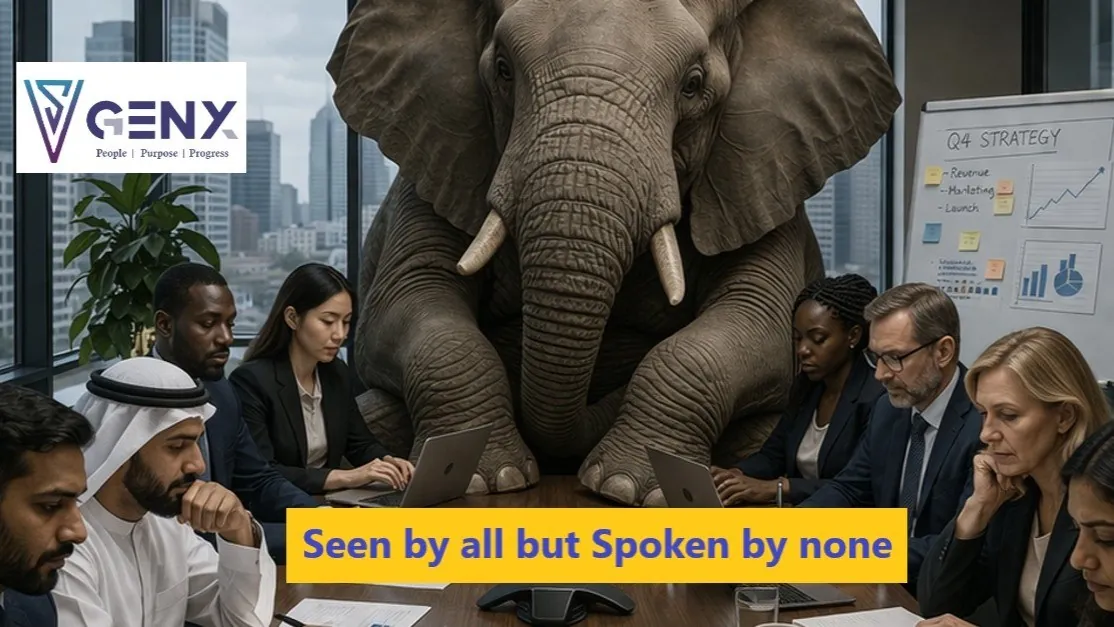
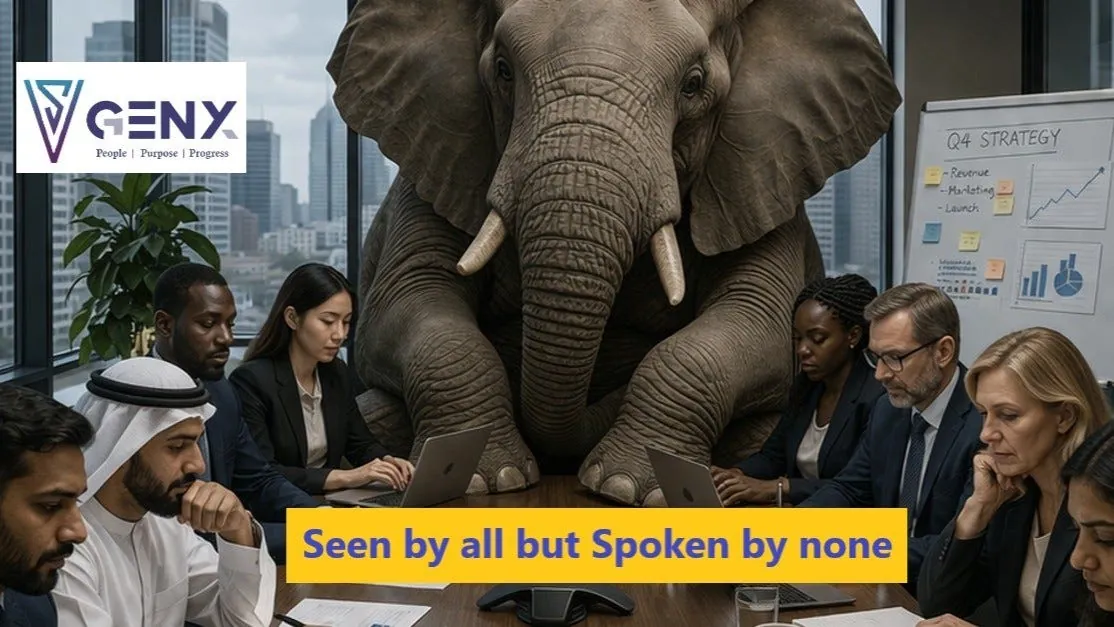
I have spent twenty years in HR. Across startups, SMEs, global corporations, and GCC’s across India and the UAE.
In that time, I have sat in hundreds of leadership meetings. And I have noticed something that nobody talks about directly.
The organizations that fail do not fail because of bad strategy, weak products, or difficult markets. They fail because of something quieter and harder to name. A set of invisible dynamics that build up slowly, that nobody points at directly, and that by the time they become undeniable, have already done most of their damage.
I call it the Silent Architecture. Here is what it looks like from the inside.
PART ONE: “Everything Is Fine.”
Arjun had been at Meridian Technologies for six years.
He still remembered what the early days felt like. Forty people crammed into a rented floor. Everyone knowing everyone. The CEO showing up with chai, sitting cross-legged on the floor next to engineers during code reviews like it was the most normal thing in the world. It felt genuinely alive back then.
Now? Meridian had crossed 1,100 people spread across three cities. And Arjun had been carrying a feeling he couldn’t quite name for months.
Every Monday, the leadership team met. Heads nodded. Decks were presented. Green lights, everywhere. “Targets on track.” “Team morale strong.” “Culture: excellent.”
Meanwhile, the hallway conversations told a completely different story. Engineers were quietly saying the deadlines were a joke. A senior product manager had updated her LinkedIn profile (always the first sign). Two of the sharpest salespeople had walked out to a competitor in the same quarter. Customer satisfaction had been quietly bleeding for eight months running.
But in every meeting? Silence. Agreement. Green lights.
What was actually happening at Meridian?
The same thing that happens inside thousands of organizations, every single day, all over the world. Nobody names it. Nobody catches it in time. And by the time someone does, it’s usually expensive to fix.
It starts with something most leaders have genuinely never come across.
THE FIRST CRACK: Pluralistic Ignorance
Here’s the thing nobody puts in leadership books:
That Monday morning, sitting in the meeting, Arjun privately thought the quarterly targets were completely unrealistic. He looked around the room. Everyone looked confident, composed, bought-in. So he kept his mouth shut.
What he didn’t know, and what nobody in that room knew, was that every single other person there was thinking the exact same thing. And every single one of them stayed quiet because they all assumed they were the only one who had doubts.
This is called Pluralistic Ignorance. It’s the phenomenon where a whole room of people privately disagree with something, but publicly go along with it because each person wrongly assumes everyone else genuinely believes it.
The outcome? An entire leadership team locked into a target that not one of them actually believed in.
The organization wasn’t being dishonest. It was trapped in something closer to a shared hallucination. One nobody consciously built. One everybody silently maintained.
Think about the last meeting where you wanted to say something but talked yourself out of it. Now imagine every single person in that room doing the same thing at the same time. That’s the room Arjun was sitting in.
THE SECOND CRACK: Evaluation Apprehension
Priya was one of the sharpest designers Meridian had. In product meetings, she often had ideas she genuinely believed could shift things. Not incremental tweaks. Big, uncomfortable, interesting ideas.
But she’d been paying attention.
Six months before, Rahul from engineering had stood up in one of those meetings and proposed a complete rethink of the on-boarding flow. Something bold. People had exchanged glances. The VP had smiled and said, “Interesting, we’ll circle back on that.” They never did. Rahul was still there, still doing good work, but you’d notice, if you were paying attention, that he’d gone quieter.
So Priya kept her ideas safe. Polished. Incremental.
This is Evaluation Apprehension: the slow, invisible process by which smart people learn to self-censor their best, most disruptive thinking. Not because they lack courage. But because the environment has quietly taught them that standing out in the wrong direction is worse than not standing out at all.
Organizations don’t lose great ideas because their people don’t have them. They lose them because the culture makes thinking out loud feel risky.
The bravest thing Priya could do in that room wasn’t to speak up. It was to protect herself. And she did. And Meridian never got to find out what it was missing.
THE THIRD CRACK: Insufficient Justification
At some point, Priya had tried to push back on something smaller: a mandatory 9am standup that made no operational sense for a team spread across time zones.
HR’s response? “It’s just how we do things here.”
No reasoning. No context. Nothing.
Here’s the strange part: when there’s no real explanation given for a rule, the human mind doesn’t rebel. It fills in the gap. Priya found herself thinking, maybe I’m missing something. Maybe there’s context I don’t have access to. Maybe this actually matters in a way I can’t see.
This is Insufficient Justification: the psychological pattern where a lack of explanation doesn’t produce resistance, it produces compliance. And not just surface compliance. People manufacture their own reasons for going along with things that make no sense, and in doing so, they attach themselves more deeply to the very norms that are holding them back.
Organizations that never explain their decisions aren’t just being secretive. They’re accidentally building a workforce that has convinced itself that broken systems are perfectly rational.
THE FOURTH CRACK: Aversion to Inconsistency
Vikram, Meridian’s CEO, had built his entire identity as a leader around the phrase “People First.”
He said it in every town hall. He signed off every all-hands with it. There was a poster with those two words in the lobby that people walked past every morning.
Last December, 47 people were let go by email. No town hall. No real conversation. A calendar block titled “Important Announcement” and then, within an hour, their system access was gone.
The people who remained didn’t just feel hurt. They felt trapped in a kind of psychological knot.
Because here’s what humans actually do when they encounter a deep contradiction between what they believed and what they just witnessed: they don’t update their beliefs. They bend their perception of reality. They tell themselves, “Well, the company had no real choice.” “Business is business, at the end of the day.” “At least I still have a job.”
This is Aversion to Inconsistency. People will go to extraordinary lengths to preserve their belief in a system they’ve invested in, even when the evidence against it is sitting right in front of them.
For organizations, this is more dangerous than it sounds. It means people will actively protect the culture that is slowly hurting them, right up until the moment they can’t anymore. And when that moment finally arrives, they don’t just walk out the door. They make sure people know why.
THE FIFTH CRACK: Palliative Function
After the layoffs, Meridian’s HR team launched something new.
Free meditation sessions on Thursdays. A kombucha bar near the cafeteria. A “Gratitude Wall” in the main corridor where people could put up sticky notes about things they were thankful for.
Engagement survey scores nudged up a few points. People smiled more in the company photos.
But the workload hadn’t changed. The accountability gaps hadn’t changed. The systems that had actually led to those 47 people losing their jobs hadn’t been touched.
This is the Palliative Function of organizational culture. It’s what happens when surface-level wellness initiatives are used, often without anyone consciously deciding to do this, to treat the symptoms of a broken structure rather than the structure itself. A way of making people feel better without fixing what’s making them feel bad.
And it’s not always cynical. Many leaders who do this genuinely believe it helps. A meditation session is a real thing that offers real, brief relief.
But you cannot kombucha your way out of a fear culture. A gratitude wall doesn’t fix a structurally unjust organization. And when the plaster eventually stops sticking, and it always does, the underlying wound has had more time to get worse.
Real culture isn’t the poster in the lobby. It’s what actually happens when things go sideways.
THE SIXTH CRACK: Outgroup Favoritism
There was something happening at Meridian that most people had noticed but nobody wanted to say aloud.
External consultants were being brought in and paid enormous fees to recommend things that internal teams had been saying, in meetings, in documents, in Slack threads, for the past two years. New hires who came from competitor companies were immediately handed “strategic” titles, while people who had been there for six, seven, eight years kept getting passed over.
The message, never spoken but completely clear, was: we don’t quite trust the people we already have.
This is Outgroup Favoritism: the tendency to assign more credibility, more intelligence, more potential to people who are new or external than to people who have been in the room the whole time.
It happens for reasons that aren’t entirely irrational. You see your long-term people in full context: their weaknesses, their blind spots, their off days. Outsiders arrive without that baggage. They seem sharper. Fresher.
But what organizations almost never sit down and calculate is the cost this has on the people who chose to stay. What it does to someone who has given eight years of genuine effort to suddenly watch a consultant get applauded for recommending what they put in a deck eighteen months ago.
Arjun knew exactly what that felt like. He had the email thread to prove the idea had been his. He didn’t bring it up. What would have been the point?
THE SEVENTH CRACK: Compensatory Satisfaction
Meena was one of the best engineers in the building. Her manager was, by most assessments, not up to the job. The project she’d been assigned to had been a dead end for over a year. She hadn’t really learned anything new in that time. By every rational measure, she should have left months ago.
But she hadn’t.
Because every Friday, her six teammates would find their corner of the office, order far too much food, and spend two hours talking about everything from system architecture to cricket scores. These were her people. That Friday afternoon, in that corner. That was real.
This is Compensatory Satisfaction. It’s the dynamic where one genuine, meaningful source of connection or purpose inside an organization quietly compensates for everything that isn’t working. A great team. A mission that still feels worth something. A friendship that makes showing up bearable.
It’s what keeps talented people in the wrong jobs for the wrong reasons, long past the point where they should have moved on. And it keeps organizations insulated from the full impact of their own failures, right up until the moment the one thing that was working stops working too.
People will often tell you they love working at a company. Sometimes what they actually mean is that they love their team, and those two things are not the same at all.
THE EIGHTH CRACK: Systemic Inertia
By Year 7 of Meridian’s growth, getting approval to change the color of a button on the app required sign-off from twenty-three separate people.
That’s not a metaphor. That is what had actually happened.
The origin of this process made complete sense at the time: three years earlier, an unauthorized UI change had broken a critical user flow and taken the company three days to recover from. One incident, one cascading response. Completely understandable.
But the incident was long gone. The process remained. Nobody had gone back to ask whether twenty-three approval layers were still proportionate, still relevant, still worth the weeks of delay they caused on even the most minor decisions.
This is Systemic Inertia. Organizations build processes to contain specific past failures, and those processes calcify. The context disappears. The problem that created them is forgotten. The process becomes self-justifying. It exists because it exists, and questioning it starts to feel like questioning something load-bearing.
And so everyone continues to operate under rules that were written for a world that no longer exists.
Every organization has its version of the twenty-three sign-offs. If you work in one, you already know exactly what yours is.
THE NINTH CRACK: Institutional Bias
Meridian believed sincerely in meritocracy. It was written into the employee handbook. “We hire on talent and promote on performance.” People said it and mostly meant it.
But if you looked carefully at who had actually been promoted over the years, a pattern was there. The people who moved up were the ones who spoke with a certain confident directness. Who held their own in aggressive debates. Who filled rooms with presence and momentum.
What happened to the engineer who delivered exceptional work without making noise about it? The product manager who was quietly building one of the most functional teams in the building through patient, careful listening? The analyst whose measured, deliberate thinking had quietly saved the company from three expensive strategic mistakes?
They got described as “not quite leadership material yet.”
This is Institutional Bias, and it’s worth distinguishing from the more obvious kind. Most organizations have made real efforts to address explicit bias. This kind is more subtle. It lives in what gets coded as “executive presence,” what gets read as “strategic thinking,” what “culture fit” actually means when people stop being diplomatic about it.
It doesn’t require anyone to have bad intentions. It just requires a system that was built by one type of person to keep recognizing and rewarding that same type of person. And over time, that system quietly drains an organization of exactly the range of thinking it needs.
THE TENTH CRACK: Creeping Normality
In Year 1, Meridian was the kind of place where the CEO replied to messages the same day and knew every employee by name.
By Year 3, response times had quietly stretched to a day or two. A handful of people noticed.
By Year 5, any communication between teams had to travel through three layers of management. Most people had just stopped fighting it.
By Year 7, teams were regularly finding out about major company decisions through news articles before anyone internal told them. People shrugged. It had become “just how things work once you scale.”
Nobody had sat down and decided to build a slow, closed, rigid organization. It had arrived in increments so small that each individual step seemed like nothing.
This is Creeping Normality. It’s the way that genuinely significant, genuinely consequential change goes completely unnoticed because it happens gradually enough that no single moment ever feels alarming. Each new normal feels like a small adjustment. By the time the cumulative picture becomes undeniable, most people can’t even remember what the organization used to feel like.
That’s the real damage. Not just that things got worse, but that everyone forgot things were ever different.
THE ELEVENTH CRACK: Situation Over Disposition
There’s a question organizations tend to ask when things go wrong.
“What is wrong with this person?”
The question that’s almost always more accurate is:
“What does this particular situation tend to do to people?”
Meridian’s customer support team had a turnover problem. Every year, a fresh intake of graduates would join with genuine enthusiasm, carry that energy through about six months, and then slowly transform into something robotic and hollow before eventually leaving.
The organization’s read on this? “Young people these days just don’t have staying power.”
The actual situation: agents had no real autonomy. Every exception to a script required three separate escalations. KPIs were built around call length (shorter was better) rather than whether the customer’s problem had been solved. The entire system had been architected, whether intentionally or not, to produce helplessness.
Put almost any human being into that environment for long enough, and you’d see exactly those behaviors. It wasn’t about the people. It was about what the environment did to them.
This is Situation Over Disposition: the understanding that behavior inside organizations is shaped far more powerfully by the conditions people operate in than by the individuals themselves.
You can’t recruit your way out of a broken system. The system needs to change.
THE TWELFTH CRACK: People in a Hurry Don’t Notice Emergencies
There’s a study that doesn’t get talked about in leadership circles nearly enough.
Researchers at Princeton took a group of seminary students, people who had chosen to spend their lives in service to others, and told them they needed to walk across campus to give a talk. Half of them were told they were running late. The other half were told they had plenty of time.
On the route, each student passed a person slumped in a doorway. Visibly distressed. Clearly needing some kind of help.
More than half the students who were running late walked straight past. Didn’t stop. Didn’t check. Just kept moving.
Some of them, by the way, had just finished reading the Parable of the Good Samaritan in preparation for the very talk they were rushing to give.
This wasn’t about who those people were. It was about what urgency does to human attention. It narrows it. Completely. People in a hurry become, functionally, blind to what’s right in front of them, even when what’s right in front of them is exactly what they’ve said they care about.
Now think about your organization.
How many leaders are so buried in this week’s deliverables that they’re not registering that two of their strongest people have gone quiet? How many managers are so locked onto the quarterly number that they’re missing the early signals of something going wrong in their team? How many CEOs are so deep in the growth story that they’ve stopped noticing the culture that made the growth possible is getting hollowed out?
Most organizations are full of people slumped in doorways.
Almost everyone is in a hurry.
THE THIRTEENTH CRACK: Weaponized Identity Management
This one is the hardest to see and probably does the most damage.
There was a group of people at Meridian who had been there from almost the beginning. They’d built things together in the hard early years. They had shared references, shared language, shared stories. They called themselves, half-jokingly, the Originals.
Over time, quietly, that identity had become something else.
When new ideas came up that challenged the way things had always been done, the response wasn’t an open debate. It was something more like a slow close. “That’s not really how we operate here.” “Once you’ve been around a bit longer, you’ll get it.” “We actually looked at something along those lines back in 2019.” “I’m not sure it’s quite right for the culture.”
The group’s identity, “the people who actually understand this place,” had been converted into a mechanism for keeping things exactly as they were. A way of dressing up institutional self-preservation as wisdom. Of making the people raising new ideas feel like they were the ones missing something.
This is Weaponized Identity Management. It’s what happens when group belonging, shared history, or cultural mythology stops being a source of genuine cohesion and starts being used, consciously or not, as a tool to shut down challenge and protect the status quo.
It’s the most insidious form of organizational resistance to change, because it disguises fear as institutional knowledge and power as stewardship.
PART TWO: The Day Things Actually Shifted
It was a Tuesday in November. Arjun was sitting in the quarterly leadership review. Slide 47 of 90 was up on the screen. Green lights, as always.
And then someone new spoke up.
Her name was Divya. She’d been at Meridian for three months, brought in as Head of People Strategy.
She hadn’t been there long enough to have learned what not to say.
She put up one slide.
One question on it:
“What does everyone in this room privately believe that they haven’t been willing to say out loud?”
The room went very quiet.
And then, slowly, for what felt like the first time in two years, people actually started talking.
Not presenting. Not positioning. Talking.
Once it started, it didn’t stop easily.
BUILDING THE ANTIDOTE: What Organizations That Get This Right Actually Do
What Divya did looks simple in retrospect. She gave the room permission to be honest. She created a container where truth didn’t feel dangerous. And from that single moment, Meridian started building something genuinely different.
Here’s what she did, and what the organizations that successfully repair themselves tend to do:
They make disagreement structurally safe, not just culturally encouraged. There’s a big gap between “we welcome honest feedback” on a values slide and actually engineering it into how decisions get made. The second version looks like anonymous input channels, skip-level conversations, pre-mortem sessions, and formally assigning someone in key meetings to argue the opposing case. Challenge has to become part of the process, not an act of personal courage.
They replace the plasters with actual treatment. Instead of asking only “how are our people feeling?”, they ask “why are they feeling this way, and what about how we’re structured is causing it?” Meditation subscriptions don’t fix 80-hour weeks. A free lunch doesn’t fix a toxic manager. The fix has to go to the root.
They go back through their processes and ask hard questions. Why does this exist? What problem was it solving? Is that problem still real? What would we do if we were building this from scratch today with what we know now?
They look at the environment before they look at the individual. When performance is consistently poor, they ask what the system is doing to people before they ask what’s wrong with the people.
They deliberately slow down. Leaders who are good at this build real pauses into their weeks: unstructured time with team members, regular spaces for the uncomfortable conversations, and culture reviews that go below the surface of engagement scores.
They name the pattern out loud. Pluralistic ignorance, in particular, breaks the moment you reveal it. When you tell a room “statistically, almost everyone here is probably privately doubting this but assuming they’re the only one” — the visible relief is immediate. Truth needs a container. Sometimes all it takes is someone willing to build one.
They stop treating insiders as less valuable than outsiders. They build actual systems for surfacing what their long-term people know: internal knowledge markets, structured input rituals, spaces where tenured employees are specifically asked what the organization should be paying attention to.
THE ENDING (THAT IS ALSO A BEGINNING)
Meridian’s turnaround took eighteen months.
Not eighteen months of big structural overhauls or expensive consulting engagements or off-site retreats with ropes courses.
Eighteen months of small, deliberate choices to be honest.
Meetings that started without a slide deck. Leaders who practiced saying “I genuinely don’t know” in public and meant it. Processes dismantled because they’d outlived their original reason for existing. An annual review process that added one question to the usual set: “What did this organization make unnecessarily hard for you this year, and why do you think that is?”
Arjun is still there. He’s the VP of Engineering now. The first thing he did in that role was take the approval process for UI changes from twenty-three layers down to three.
He printed out the old process documentation and had it framed. It’s hanging on his office wall.
Not as something to be proud of.
As something to remember.
A NOTE ON WHAT WE DO
VS GenX Solutions exists for exactly this.
We work with founders, CHROs, and leadership teams who have started to sense that something in their organization is not quite right, but cannot yet name it clearly enough to fix it.
Our Cultural Transformation Studio is built around exactly the kind of honest, structured work that Divya did at Meridian: surfacing what is real, mapping the gap between the culture that exists and the culture that is needed, and building a practical path from one to the other.
If you recognized your organization in any of these thirteen cracks, we would be glad to have a conversation.
ONE QUESTION FOR YOU
Right now, in your organization, which of these thirteen cracks is doing the most damage?
Is it the silence in the room where everyone privately agrees but nobody says anything? The processes nobody has questioned in years? The wellness initiatives papering over structural problems? The people who have learned that their best ideas aren’t welcome?
You do not have to name your organization. Just name the crack. Drop it in the comments. I read all of them.
If this kind of thinking is useful to you, subscribe to The VS GenX Insight. We publish one piece like this periodically on HR, leadership, culture, and the dynamics that quietly shape organizations.
And if something here landed for you, share it with one person in your organization who you think should read it and encourage that person also to subscribe.
Because the silence that eventually breaks organizations doesn’t start in boardrooms or strategy decks.
It starts when one person knows the true thing and decides, just this once, not to say it.
And then does it again. And again. Until it becomes the culture.
Written by someone who has sat in too many all-green status meetings where absolutely nothing was fine….

Venkatesan Srinivasan Founder, VS GenX Solutions
HR Strategist. Change Architect. Theater-Based Leadership Facilitator. 20+ years across India, UAE, and Southeast Asia helping startups, SMEs, and Global Capability Centers build people functions that actually work.
🌐 vsgenxsolutions.com 💼 linkedin.com/company/vs-genx-solutions 📩 enablement@vsgenxsolutions.com
Originally published on Venkat's Substack. Subscribe for free to receive new articles.