
Rohan walked out of a two day leadership offsite on Friday evening feeling like a changed man.
By Tuesday morning, he was back to interrupting his team in every single meeting.
Nothing about him had actually changed at all. Only his notebook was fuller, and only one invoice had been paid.
I have watched this exact story repeat itself across banks, GCC’s, IT services, Products, Aerospace and Consulting firms for over 25 years now, and every single time, everyone in the room talks about the training fee. Almost nobody talks about the real bill, the one that arrives quietly over the following twelve months, long after the facilitator has packed up and left.
This piece is about that real bill. What a two day leadership workshop actually costs, in India and globally. What it costs you again when the behavior does not change. And why we built Ready for Next at VS GenX Solutions to turn that spend from an expense you write off into an investment with a committed Return on Business Value, or RBV, that we track with you, not just a feedback form we collect and forget.
The bill nobody itemizes
Leadership training is now a genuinely large global industry, which is exactly why organizations keep buying more of it without asking harder questions.
The global corporate leadership training market was valued at close to 39.6 billion dollars in 2025, and it is projected to nearly double to about 73.7 billion dollars by 2034.
India’s corporate training market alone was worth an estimated 12.2 billion dollars in 2025, and it is expected to more than triple to nearly 39.9 billion dollars by 2034, growing at close to 12.9% a year, according to market research firm IMARC Group.
That is roughly one trillion rupees of spend a year in India already, on a category where McKinsey finds that only 7% of senior managers believe their own organization actually develops leaders well.
Read that number again slowly. This is not outside criticism. That is the internal verdict of the people signing the cheques.
What a single two day workshop actually costs in India
Here is where most business cases quietly stop, at the invoice line.
Published Indian benchmarks for corporate leadership programs look roughly like this, per participant, all-in:
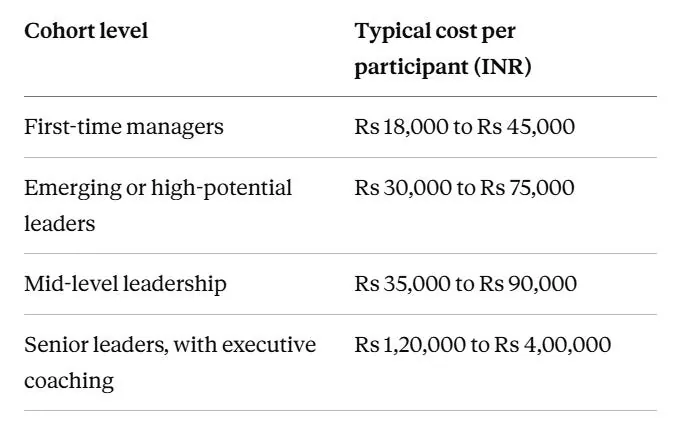
Now take a realistic, mid-sized example. Say an Indian organization sends a cohort of 40 mid-level managers for a standard two day leadership workshop, at the midpoint of that mid-level bracket, roughly Rs 60,000 per head.
Direct fee alone: Rs 60,000 x 40 managers = Rs 24,00,000 (about 24 lakh rupees, or roughly 29,000 US dollars).
But that is only the invoice. It is not the cost.
Every one of those 40 managers is also away from their actual job for two full working days. Assume, conservatively, a fully loaded cost per manager of about Rs 12,000 a day, a reasonable figure for someone on a mid-management salary once you account for their full cost to the business, not just their take home pay.
Opportunity cost of lost working time: Rs 12,000 x 40 managers x 2 days = Rs 9,60,000 (about 9.6 lakh rupees).
Visible cost of one workshop for one cohort: roughly Rs 33,60,000, or about 40,000 US dollars, for two days.
Most HR budgets stop the math right there, and that is the real mistake.
The invisible bill that arrives after the workshop ends
Here is the part almost nobody puts in the business case, even though it is usually the larger number.
The entire reason these 40 managers were sent for training in the first place was some form of behavior gap: poor delegation, weak feedback, low trust, high attrition in their teams. If the workshop does not change behavior, and the research says it overwhelmingly does not, that original problem simply continues, quietly compounding for another year.
Gallup’s research puts hard numbers on what that continuing gap costs.
52% of employees who voluntarily leave a job say their manager or organization could have prevented their departure, most often simply through a real, ongoing conversation about their growth and concerns.
Replacing an employee typically costs anywhere from half to two times their annual salary, once you count recruitment, lost productivity during the gap, and ramp up time for whoever replaces them.
Assume each of those 40 managers has around 10 direct reports, roughly 400 people in total. Assume, conservatively, that just 2% of that group, about 8 people, leave within the year for reasons that better managerial behavior could plausibly have prevented. At an average annual salary of Rs 8,00,000 and a conservative 0.75 times replacement cost, that is:
Rs 6,00,000 per exit x 8 exits = Rs 48,00,000 in avoidable attrition cost, in a single year, from just this one cohort’s teams.
Add that to the roughly Rs 33.6 lakh already spent on the workshop itself, and the real first year cost of “one more workshop that does not stick” is closer to Rs 80 lakh or more, against an original invoice of Rs 24 lakh that HR actually signed off on.
And this figure still excludes the productivity and profitability gap Gallup measures at a global level, where highly engaged teams deliver 18% higher productivity and 23% higher profitability than disengaged ones, and where global workforce disengagement is now estimated to cost the world economy about 10 trillion dollars a year, roughly 9% of global GDP. Manager engagement itself fell from 27% to 22% in a single year recently, the largest year on year drop Gallup has recorded, at the exact moment organizations are leaning hardest on managers to hold teams together.
None of these numbers are unique to any one company. They are the ordinary, unglamorous arithmetic sitting underneath almost every “one more workshop” decision made this quarter.
Why the money does not buy behavior change
This is not a facilitator quality problem. It is a design problem, and the evidence on why is now very consistent.
Adults retain barely 10% of what they hear in a classroom lecture, compared to nearly 65% of what they learn by doing real work on real problems, McKinsey’s own research on leadership programs shows.
The Ebbinghaus forgetting curve, tested and retested for more than a century, shows that people forget close to 70% of new material within 24 hours if nothing reinforces it.
Only 34% of executive teams report strong alignment on priorities once they return to their desks after a leadership offsite, and Harvard Business Review’s own research finds that 67% of well formulated strategies fail simply on execution, not on design.
A recent Psychology Today review of the evidence, published this year, framed the core issue in one line worth sitting with: knowing what to do is simply not the same as doing it.
Two days of role play cannot outrun a forgetting curve. Enthusiasm is not a mechanism. A feedback form with a 9 out of 10 score is not proof that anyone’s Monday changed.
From training cost to Return on Business Value
This is exactly why Ready for Next, our flagship leadership program at VS GenX Solutions, was never built as a two day event.
Ready for Next is a sustained leadership journey, built on our HUMAN Leadership Framework, our Theater Based Learning method, and Raja Krishnamoorthy’s 5S Transformational Leadership Model, reinforced through our RESET confidence framework across weeks, not hours. Leaders on this journey do not just discuss behavior in a room. They rehearse it, apply it to their real decisions and their real teams, get coached against it, and get held accountable for it long after the workshop banner comes down.
But we also believe the commercial conversation around leadership development has to change, not just the classroom design. That is why every “Ready for Next” engagement is built around what we call Return on Business Value, or RBV, instead of a training completion certificate.
In practice, that means three things, agreed with the sponsoring leadership team before the program begins, not after.
First, we baseline the real business metric behind the behavior gap. Not a generic satisfaction score, but the specific number the organization actually cares about: attrition inside that leader’s span of control, team engagement pulse scores, escalation or rework rates, internal mobility and succession bench strength, whatever is genuinely driving the original decision to invest.
Second, we build the reinforcement architecture the research says is non negotiable. Spaced practice over weeks, coaching on real decisions rather than case studies, and an environment redesigned to reward the new behavior, not just the old results.
Third, we report the movement on that same business metric at 60, 90 and 180 days, back to the leadership team that sponsored the spend, not only to L&D. The conversation moves from “how was the workshop” to “what moved in the business”, which is the only question that ever justified the budget line in the first place.
That is the difference between a two day expense and a Return on Business Value investment. One is written off the day it happens. The other is designed to still be showing up in the numbers six months later.
The question worth asking before the next workshop gets booked
If your organization has sent managers for one more workshop this year and quietly wondered why nothing changed by Monday, the real answer is sitting in the math above, not in the facilitator’s slide deck.
Before you approve the next leadership program, ask what it will cost if it works exactly as well as the last one did. Then ask what a program built to be measured against a real business outcome, rather than a feedback score, would need to look like instead.
I would love to hear from you. When was the last time a leadership program actually changed how someone behaved at work, weeks after it ended, and how did you know?

Venkatesan Srinivasan, Founder - VS GenX Solutions
People | Purpose | Progress
Sources
Does Leadership Training Change People? — Psychology Today, August 2026
The Monday After: Why Leadership Off sites Fail — Metronomics
India Corporate Training Market Size and Report, 2034 — IMARC Group
This Fixable Problem Costs U.S. Businesses $1 Trillion — Gallup
The $10 Trillion Wake-Up Call — Outsource Accelerator, on Gallup 2026 data
#Leadership #LeadershipDevelopment #ReadyForNext #VSGenXSolutions #HR #ROI #OrganisationalDevelopment #GCC #FutureOfWork
Originally published on Venkat's Substack. Subscribe for free to receive new articles.