More than 25 Global Capability Centers shut down across India in 2025. Industry advisory firm Neovay projects that number could double in 2026. The casualty list already includes Opendoor, Hy-Vee, and a Wells Fargo center in Chennai that closed and cost a few hundred people their jobs. Oracle, Walmart Global Tech India, Aumovio Ford and Fidelity Investments have all been through significant downsizing in the same period.
Now sit that fact next to the headline everyone is celebrating. India hosts 2,117 GCC’s generating a combined 98.4 billion US dollars in revenue, up 32 per cent in five years, according to the Nasscom-Zinnov GCC Value Orbit report released in July 2026. As many as 506 of the Forbes Global 2000 companies now run an India operation.
Both facts are true at the same time. That contradiction is the entire reason I spent the past weeks pulling this research together, and it is the reason I believe every leader in this ecosystem, wherever in the world they are running a centre, needs to sit with it before writing the next scaling plan.
I did not read about the GCC story from the outside
I lived through its earlier chapter, as did most senior leaders in this community. Many of us spent fifteen, eighteen, twenty years inside Offshore Development Centers that never called themselves anything as fashionable as a Global Capability Center, yet quietly did work a great many of today’s GCC’s are still trying to reach.
The best ODC’s were never delivery factories. They ran large-scale product engineering programs. They led automation and process excellence initiatives that changed a client’s underlying cost structure, not just their invoice. They operated multi-vendor ecosystems and carried CMM Level 5 process maturity as table stakes, years before vendor governance became fashionable GCC vocabulary. The leaders who ran them balanced customer expectations, operational excellence, quality, revenue growth, profitability, risk and talent development, often for teams of a thousand people or more, often while headquarters still treated the relationship as a vendor contract.
Today’s GCC genuinely is different. It owns intellectual property. It influences enterprise strategy directly, not through a specification handed down from elsewhere. Walmart Global Tech India, run mainly out of Bengaluru and Chennai, has moved from support functions to full product ownership in predictive analytics and supply chain AI, work recognized in 2024 with the Minsky Award for Best AI Implementation in a Captive Environment. That is real evolution, and I do not want to understate it.
But strip away the AI dashboards and the product-ownership language, and a GCC still has to solve the exact organizational problem a great ODC solved. It has to build trust with a headquarters eight time zones away. It has to prove, quarter after quarter, that the value it creates outweighs the cost it represents, because the moment a sponsor changes at headquarters, that question gets asked again from zero. This is precisely where the ODC generation’s leadership discipline transfers without modification, and it is the thesis this research sets out to prove with data rather than opinion.
What actually separates the Centers that scale from the Centers that close
Every retrospective on India’s 2025-26 GCC closures names the same root causes: a change in corporate sponsorship the center had no mechanism to survive, a persistent perception of the department as a cost line, a lack of empowered local leadership, and workforce growth without a matching rise in specialist skill. Every one of those four causes has a name, and the name is governance failure, not market failure.
Set against that, nearly half of India’s GCC’s have climbed to Portfolio Hub maturity or beyond within five years, a level that historically took five to ten years to reach, according to Zinnov’s Maturity Framework.
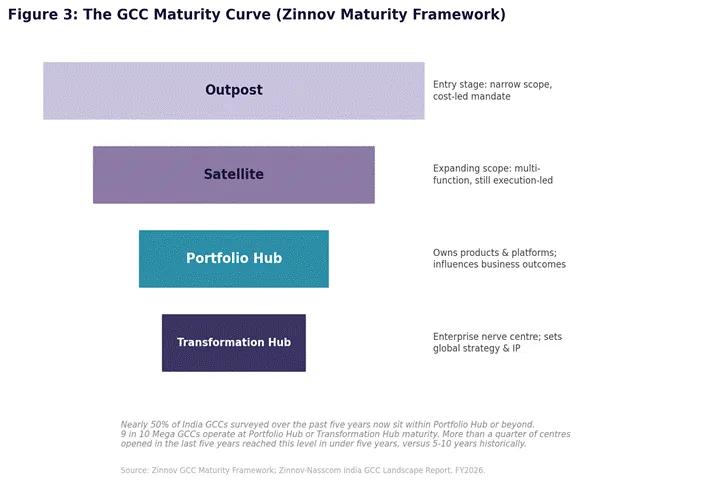
The GCC Maturity Curve. Nine in ten Mega GCC’s now operate at Portfolio Hub or Transformation Hub level.
Retail offers the sharpest illustration of what happens when governance lags capability. Only 17 per cent of retail GCC’s have reached Portfolio Hub maturity, compared with 44 per cent in automotive and near-universal Portfolio or Transformation status in software companies, despite retail sitting on some of the richest data assets in the entire ecosystem. Zinnov’s own analysis is blunt about why: the gap is not talent access. It is that the operating model and mandate never evolved at the pace the capability did.
The story does not stop at India’s border
Most commentary on this topic treats India as the whole conversation. I wanted to know what the same governance lens shows when held up against the other geographies enterprises are actively weighing right now: the Philippines, Poland, and the UAE.
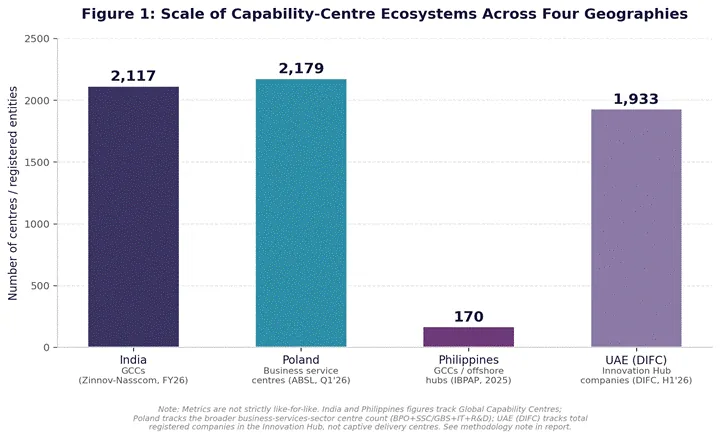
Scale of capability-center ecosystems across four geographies (methodology notes in the full report).
Philippines: trading scale for depth
The Philippines’ GCC market stood at 35.12 billion dollars in 2025, projected to reach 55.59 billion by 2030. But the more interesting signal came out of GCC Forum 2026 in Manila, where industry leaders described a deliberate pivot away from large-scale operations toward specialised nano- and micro-GCC’s, smaller, sharper units built for enterprise-grade technical value rather than headcount. The Philippines is trading scale for depth, a genuinely different bet from India’s.
Poland: the quiet ownership shift
Poland’s business services sector crossed 500,500 employees across 2,179 Centers by Q1 2026. Its industry association, ABSL, used a striking phrase in its own 2026 report: the sector is undergoing “a deep qualitative transformation from a service-provider model to the role of owner and integrator” of global business processes. IBM’s Krakow software lab, running since 1991 and now over 3,500 professionals strong, is a three-decade proof point of exactly the kind of sustained governance maturity this report argues India’s newer GCC’s are compressing into five years.
UAE: governance before scale
The UAE does not compete on classic delivery scale at all, and treating it as though it does misreads the market entirely. Dubai’s real play runs through DIFC, an English common-law jurisdiction that announced in April 2026 its intention to become the world’s first AI-native financial center, building its legal and regulatory framework around artificial intelligence before scaling delivery capacity around it. That sequencing, governance first, capability second, is the exact inverse of how most GCC’s in every other geography have historically grown, and it is worth genuine attention.
One caution for any global reader: in a Gulf business context, GCC as often as not means Gulf Cooperation Council, not Global Capability Centre. A board discussing “GCC strategy” across a Dubai regional team and a Bengaluru delivery team may be having two entirely different conversations without realising it.
Where does that leave India’s edge
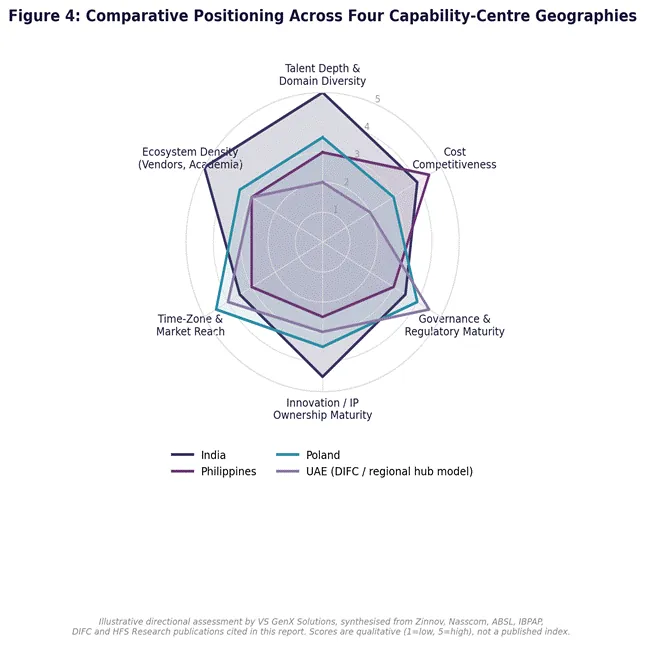
Comparative positioning across India, the Philippines, Poland and the UAE (illustrative synthesis, full methodology in the complete report).
India’s edge is not simply being the cheapest or even the largest by every measure. Poland’s center count is comparable. The UAE’s registered-company growth currently outpaces India’s GCC growth rate. India’s compounding edge is density, the simultaneous presence of deep engineering and AI talent (roughly 28 per cent of global GCC AI talent, second only to the United States), a two-decade-old vendor ecosystem inherited directly from the ODC era, a fast-expanding academic partnership model (Novo Nordisk’s Bengaluru centre is now building proprietary pharmacometrics capability with the Manipal Academy of Higher Education), and a maturity curve compressing faster than history would predict.
That density took two decades to build. It cannot be replicated at speed anywhere else. It is also precisely what is at risk the moment a center’s internal governance fails to keep pace with the external opportunity in front of it.
The question I would like this community to sit with
Technology will keep differentiating GCC’s for a season, until the next center licenses the same tools. People will keep powering GCC’s, until the same talent gets hired away by the center next door offering ten per cent more. Governance is the one variable that cannot be copied from the outside, because it lives in how decisions actually get made inside an organization , especially on the days nobody is watching.
Perhaps that is exactly why governance deserves to be treated as the next competitive advantage, not an afterthought bolted onto a scaling story once the story starts to wobble.
A note on the fuller research
This piece is a public, abridged edition of a longer cross-geography research report VS GenX Solutions has just completed, comparing India, the Philippines, Poland and the UAE across scale, maturity, governance and cost, with a detailed comparison framework and additional data visualization not included here.
Research of this depth, cross-referencing NASSCOM, Zinnov, ABSL, DIFC and HFS Research data across four geographies, is typically the kind of briefing enterprises commission from global advisory houses. We are releasing it as VS GenX Solutions’ inaugural research report, complimentary, to open a conversation with the leaders building and running these Centers today.
If you are running, scaling or advising a GCC, and would like the complete report, reach out to me directly or connect with VS GenX Solutions. I would also genuinely like to hear where your own governance model has been tested hardest, and what changed the day a sponsor at headquarters moved on.
Author :
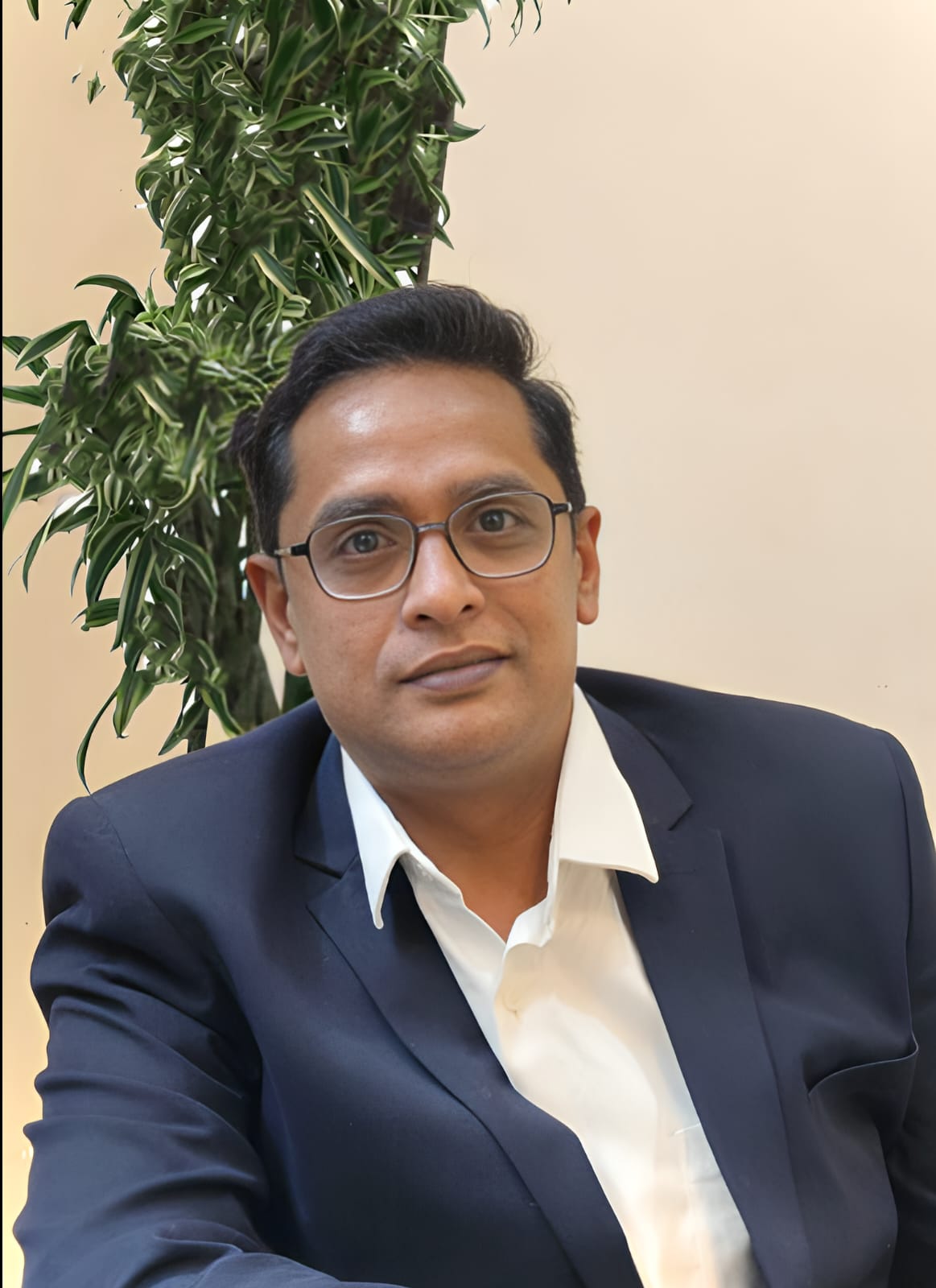
Venkatesan Srinivasan, Founder of VS GenX Solutions LLP, an HR and leadership consulting firm working with GCC’s, startups and SMEs across India, UAE, SriLanka, Southeast Asia and Africa.
email id: enablement@vsgenxsolutions.com
website: www.vsgenxsolutions.com
Originally published on Venkat's Substack. Subscribe for free to receive new articles.